X

My tastebuds tell me I’m Japanese

Ka’Olu,
Los Osos, CA

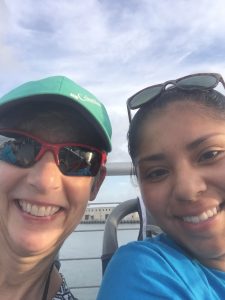
I’m a “third culture kid” raised in Southern California by expat Japanese parents. We were repatriated when I was a teenager, then I moved back to California in my late 40’s. In Japan, I felt I was not really Japanese, but in the US, I don’t really feel American. Because I don’t have an Asian accent, people (like my Anglo-American husband’s family) seem to think I am just like them. I’m not. My food preferences are definitely Japanese! This recent photo makes me laugh. Camping is such an American pastime, but here I am with my chopsticks! I always travel with them, along with bags of rice and little packets of soy sauce.

Anglo interloper newcomer outsider awkward minority

Laurie Mitchell Dunn
Taos, NM

In my northern NM community, Native Americans have been here for over 1,000 years and Hispanics for 400 years. Anglos are both minorities and relative newcomers (first arriving about 150 years ago). Even native born Anglos aren’t really accepted as “locals”. The Hispanics here have a saying: “Just because your cat has kittens in the oven, it doesn’t make them biscuits.” It’s an eye-opening glimpse at what it’s like being in an ethnic and cultural minority, although I can’t claim to have even remotely experienced what people of color deal with almost everywhere in the US.

My tastebuds tell me I’m Japanese

Ka’Olu,
Los Osos, CA

I’m a “third culture kid” raised in Southern California by expat Japanese parents. We were repatriated when I was a teenager, then I moved back to California in my late 40’s. In Japan, I felt I was not really Japanese, but in the US, I don’t really feel American. Because I don’t have an Asian accent, people (like my Anglo-American husband’s family) seem to think I am just like them. I’m not. My food preferences are definitely Japanese! This recent photo makes me laugh. Camping is such an American pastime, but here I am with my chopsticks! I always travel with them, along with bags of rice and little packets of soy sauce.

Blacks say I’m White, WASPs don’t.

Thomas R Gerbasi,
Lewiston, NY

I’m Sicilian-American. Both sides of my family came to the USA in 1890s The KKK burned a cross on my Grandfather’s lawn. As a teenager, they offered my father twice what he paid for his home to move out because a “non-white” family in the neighborhood would “lower the property values.” Folks see my name on a name tag and compliment me on my ability to speak English. Yet for the purposes of surveys, I am asked to identify myself as either “white” or (incredibly) “Anglo” (even though there is not a drop of Anglo-Saxon blood in my heritage).

You can sit in the bar

Diane Graves,
San Antonio, TX.

My husband and I (both Anglo) were driving our adopted daughter (born in El Salvador, adopted as an infant, a U.S. citizen since she was 11 months old) to a guest ranch in Colorado. It was 2004; our daughter was 11 years old. Late on Sunday morning, we stopped to have lunch in Alamosa, CO. My husband entered the restaurant first, and my daughter and I busied ourselves at a postcard rack while he asked for a table. The white, male, college-aged host eyed our family, spotted our daughter, and said, “You can sit in the bar.” My husband asked, “Why would that be? I see plenty of tables in the main dining room.” It was pretty clear why. Fortunately, a young female waitress pulled up and said we were welcome in her station. We were stunned–and grateful that our child didn’t realize what had happened. She only learned about it this year, when I asked her if I could submit this story. We are glad we live in multiracial San Antonio, but still worry what kind of nation we are becoming–and if our daughter can ever be accepted as American in the rest of the country. Recent rhetoric would indicate that she will have to be alert for profiling and other forms of bias. My heart is breaking now as it did that day. How many other people of color experience this kind of bias on a daily basis? We all can do better. We can BE better.

Where did you meet your wife?

Brian Comerford
Aurora, CO

I notice when many husbands are asked a similar question, the word “where” is substituted with “how”; my impression is that because I am a white Anglo male married to a Southeast Asian woman with a foreign accent, the question is actually front-loaded with curiosity about whether or not we were united through sexual tourism. It probably doesn’t help that even though we’re three years apart in age, my wife looks 10-years my junior, further feeding a bias – sadly – that “some men simply go wife-shopping”, particularly in third-world countries.

Wishing I knew my own language.

Celestina Garcia,
Bloomington, IN.

Cripplingly aware of my Hispanic heritage, yet I feel that it doesn’t belong to me. I have my mother’s Anglo nose, and my fathers Mexican brows. I wade through a sea of whiteness wishing to connect yet when I find a Chicana we find that we aren’t on the same page… maybe we can’t even speak the same languages. My desire to connect to my heritage keeps me up in the dark hours of the night, but I never know what to say. Like they say: I’m neither here, nor there.

Don’t make assumptions. Just ask questions.

Stephanie Woodworth,
Piscataway, NJ.

My six words are in reference to how hesitant (in some cases, even terrified) people are to talk to each other when differences are involved. It’s as if even the most well-meaning people become paralyzed at the thought of acknowledging not only our differences, but our collective level of ignorance about one another. And so, in an effort to hold on to the appearance of what we hope will be seen as being open, accepting or even “colorblind” (yuck, my absolute least favorite), we make the bigger mistake of acting from assumptions. It’s as if we think asking someone about their life, their reality, will somehow be perceived as offensive or ignorant. I’ve personally never encountered this. I feel like it is my way of showing respect for experiences that are different than my own by not assuming I understand, but giving others the chance to represent their own experiences. I’ve honestly never had anyone take offense at this approach.
As for me, being the picture of a lily-white Anglo American (everyone assumes Irish, because of the red hair), it never fails to surprise people when they discover that, while I do have some Irish, Scottish and English on my mother’s side (although, not enough to identify which county or clan I hail from), I grew up surrounded by the culture, food and vernacular of my father’s family, who hail from Jamaica. The funny thing is that it is non-Jamaicans who have the hardest time believing that my dad is from Jamaica. Jamaicans I meet are at first surprised, but quickly accept it, since they know how diverse the islands can be (how many times have I looked into disbelieving faces when I mentioned the large Chinese population in Jamaica, who SOUND like Jamaicans). The sad thing is that I have always wanted a culture that I could connect to, and though I have tons to choose from in my background, the one that was so familiar in my childhood no longer feels open to me, now that most of my family is spread out, or gone. My father has always been so gung-ho about being American, that he doesn’t even identify as Jamaican. And it’s not a simple matter of joining a club. My face doesn’t exactly scream, “Jamaican”, in fact, it screams anything but. My white skin, red hair and freckles scream, “privileged Anglo white girl”, and that is partly true. But, how do I celebrate and participate in a culture that I bear no physical resemblance to and no longer have access to?

I’m one of the rare ones.

Nabeste,
Chicago, IL.

I’m a Mexican-American. I hate white people. I have grown to hate them. They came to America to steal the land and kill the Native American Indians. They brought the slaves here. They brought with them diseases that are here now. They went and took Texas and all the states that belonged to Mexico. And still these people claim that they want America 💯 anglo? Go back to Europe if that’s what you want. I wish the Indians would have never let the Europeans put a foot on this land.

Haole boy, Hawaiian, keiki o ka’aina?

Claire Iveson
Kaunakakai, HI

My blonde Anglo son was raised and educated on Molokai, before going to the Berkley College of Music at 17. He was aware from kindergarten that he was a “haole” but didn’t understand that he wasn’t also Hawaiian. Adult Hawaiian friends assured them that he was a keiki o ka’aina, a child of the land. And this he shares with Barack Obama!

Dark White Guy, Please Stay Mute

Joe DiPietro
Oakland, CA

As a short, dark white guy who’s been called “kike,” “spic,” and “raghead” by white guys, “gringo” or “anglo” by Hispancis, “dago” and “WOP” by blacks, I’ve learned what voice I have in the discussion about race and ethnicity. None. Yeah, I know–I haven’t lived the oppression. I’ll be a good boy and shut up now. Hope that pleases everyone.

Join the Newsletter

Subscription to our newsletter open soon.

Indulge in timeless elegance with our hand-curated collection of luxury vintage men’s fashion. From classic suits to iconic accessories, our online store offers a premium shopping experience for the modern gentleman who appreciates quality and style. Shop now and elevate your wardrobe with our carefully selected pieces that celebrate the art of craftsmanship and heritage fashion.