
To fit everywhere and nowhere.
Madison Le Lam Carter
Canada
Chinese/Vietnamese and Irish/Scottish
The Race Card Project
By Michele Norris
Madison Le Lam Carter
Canada
Chinese/Vietnamese and Irish/Scottish
Gil L. Pettigrew, MS,
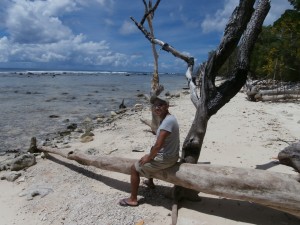
The Federated States of Micronesia.
I have a very strong, very proud cultural heritage; I’m a North American Mestizo, 50% Native American (Creek and Cherokee; my tribal enrollment/citizenship is with the Echota Band of the Eastern Cherokee Nation) & 50% a mashup of Scots-Latin-AfricanAmerican-Welsh-french.
I self ID as Native American, because I am, culturally, legal, socially, that’s the most marginalized part of my heritage…& at 2% of the America population we need the numbers &/or multiethnic-mixed race.
Appearance-wise, I’m taken for everything from Native Hawiian to Middle-Eastern, though usually I’m seen as puro Latino.
Rather than getting annoyed by that, as some multiethnics are, I embrace being, in Hollywood speak “generic brown”; it means I have a global-face, a phenotypic in with folks from lots of different backgrounds. Its been especially useful living in my diverse, polyglot home-city of Miami, FL, & traveling in Latin America, the Caribbean (I, for example don’t often pay “Gringo Prices”), & I’ve found it an advantage since taking a position as the natural science instructor at The College of Micronesia’s Kosrae Campus, on the island of Kosrae, in The Federated States of Micronesia…I find folks a bit more open, a bit more upfront with me than I’ve observed they are with many more obvious Westerners, since they frequently tell me they initially assumed I was from one of the neighboring islands.
Xacu
Seattle, WA
The country we came from views us as bad and wrong. We were conquered, killed, and hated. Laws were made against us, we were disallowed to speak our own language, forced to speak theirs. When I say hunted, I mean there were death squads sent out by the government that took 21,000+ lives. The squads enjoyed themselves, howling, singing, and taunting people. They pulled people into town squares to make examples, and left corpses in place for days. Because we were other, we needed to be put in our place. Our culture was banned, our ethnic dress was banned, our lives were robbed.
There are factions who fight against the government, and because of it a beautiful homeland has become a barren battleground in some places. People shot in front of elementary schools, bombings, kidnappings, you can see people becoming the worst version of themselves because this war has turned them into it — and to the rest of the world this war is invisible. We do not make headlines because our country is small and our meaning to the world is not what it could be. Coming to the United States, I changed from being othered for my ethnicity to simply being White — and I cannot tell you the relief of it. I grew up knowing what it was to be othered under threat of violence or death, so when I hear white people in this country bring up reverse racism, or rolling their eyes at POCs it makes me shudder. It makes me bitter. It makes me wish I could show them my home and tell them “You don’t understand what that battleground is. All of the horrors that can be seen there is etched on my heart, but I was allowed to leave. People of color are not permitted to leave as I have and find somewhere that they are no longer othered. For them this battleground is everywhere. Because white privilege exists everywhere.
I was able to leave and no longer be under threat for my ethnicity. They have no such luxury.” and in that moment I both understood nothing and enough at the same time. Because while one soldier knows another, the battles they see are different than mine, and I cannot speak about race in earnest while existing in a safety they can never reach. Wars exist because communication dies. Shut up. Listen to these people. Stop being instantly defensive. That is how words escalate to violence. Violence becomes hate. Shut. Up. And. Listen. With your heart open, and your mouth closed.
Ed Milkow
Los Banos, CA
I think it’s time we moved away from the language of racism. It feels false to most people, and ends more conversations than it starts. Very few people would recognize themselves as racist, and, in fact, it has been my observation that racism – the thought that a group of people are inferior based on their heritage or skin color – has become rare.
But racial BIAS? I haven’t met many people that don’t harbor SOME form of racial bias. Sometimes we see it as cultural, sometimes we call it profiling, but it is a BIAS. Sometimes our bias comes from experience – I have a friend who had a bad experience with 3 Indian doctors, and now won’t go to another one. Sometimes from media stereotypes…
But I think if we can change the language of the discussion, more people will participate.
Lisa Schlosberg
Ann Arbor, MI
Understanding Race Project- University of Michigan
The facilitators of a race and ethnicity activity asked us to walk
from one side of the hall to the other if we had ever been followed
around in a store while shopping. The lone black girl of our group
took a step forward, no one else moved, and we all stood there looking
around at the situation society had just created for us. This moment,
in addition to the personal memoirs and articles we read for class
about racism, have truly opened my eyes to the fact that racism isn’t
somewhere out there, it’s right here and now. Furthermore, it is
everywhere and all the time.