X

My Dad said “Jap”. Everyone blushed.

Malcolm Gin,
Berkeley, CA.

My Dad is Chinese and 86 years old. He was stationed in the Pacific Theater during World War II, fighting on the United States’ side. Nearly got his butt shot off several times for looking and being Asian, by our own side. Lately he was talking about his experiences in the war with a Japanese acquaintance and, in the moment, called the soldiers on the Japanese side, “Japs”. And all the white people participating in the conversation got really on-edge, though I don’t think my Dad, our Japanese guest or I (half Chinese, half white) were nearly so bothered. My only thought at the time, “There’s worse words than that!”

Now, I can protest that murder

David C. Ruffin
Washington, DC

I participated in the March on Washington in 1963. I was 18 and home on leave from the Air Force. My most enduring memory of the March was a conversation I had with an older man on the train ride from Pittsburgh to Washington the night before. He told me that when he was in the Army in the Jim Crow South during World War II, he witnessed the murder of another black soldier. He was powerless to do anything about it at that time, but the March finally gave him an opportunity to protest the killing.

I had been based in Texas where I was subjected to racial discrimination. The March was also means for me to stand up against racism. Below is my short remembrance of that time.
Stood-Up-at-March

Your bar is down the street.

USMC-1967-1971Ronald Zeigler,
North Brunswick, NJ.

I was stationed at Parris Island going to Personnel school. I was from New York and with my three New Jersey (also Black) friends went into Beaufort, SC. We walked into a bar and my friend said “three beers, please”. I was at the jukebox looking for Motown and finding The Grand Ole Opry. Those six words were what the bartender said…twice. We left, walked down the street and was greeted with wall to wall us, The Four Tops and The Temptations.

I am white. So?

Alan S. Doctor,
Cambria, CA.

I was born in San Francisco on 15 Sep 1930. Dad was Scotch/English and Mom was Polish with a dash of German. Both 1st generation born in USA.

My neighborhood friends were Hispanic, Oriental, white and refugee Jews from Germany. In high school I liked to walk home through the Fillmore district and fell in love with Dixie and other jazz. I would stop in front of the Negro clubs to listen and was frequently invited in. Never a problem.

I excelled in Army ROTC and graduated a Cadet Major. I enlisted Army in May 1949 and had Basic at Fort Ord, CA. The armed services were integrated by order of President Truman in 1947, I believe. The Army was struggling with this, still is. I remember a few black Trainees and one in my Platoon. He and I became friendly enough for me to go to his home in Compton, CA for a weekend and he came to my home in San Francisco for a weekend. We both had asked for training as an automotive mechanic and travelled together to the Ordnance Automotive School in Atlanta, GA. We departed Los Angeles via UP and were not treated well because we were Soldiers. We changed crews somewhere in Texas to SP. What a difference. Very good treatment.
Our duffle bags were delayed and we only had the OD uniform we travelled in. The bags showed up in 3 or 4 days and we had clean clothes. We decided to look around Atlanta and took the civilian bus downtown.. The driver stopped just outside the main gate and ushered all black troops to the back of the bus. We were shocked. I had heard about Jim Crow, but new nothing about it. The two of us could go nowhere together. After graduation I was assigned to an Ordnance unit at Ft. Riley, KA and saw more Jim Crow, Not as severe as in Atlanta.
On 15 Sep, 1950 I celebrated my 20th birthday in Pusan Korea and spent the next 12 months serving with the 1st Cavalry Division as an Infantry man and eventually as a Squad leader. We had a few black troopers and I don’t think that anyone really noticed. I was too busy trying to live. I was pleased to have people I could trust on my flanks.
I spent my 3rd year of active duty at Ft Huachuca, AZ where I served as the Bn. Personnel Sgt. Returned home to San Francisco, Got married and re-enlisted in the Army Reserve and, eventually, the Calif. Army National Guard. I retired with the rank of 1st Sgt. in 1981. There was a large number of Hispanic soldiers in the National Guard. My unit had one black officer and one black Platoon Sgt. I don’t recall any problems with anyone. We had a job to do and we worked together. My personal concern at that time was Vietnam. We were not ordered into active duty
thank God.
My unit was sent to perform Riot Control in Watts during the race riot in 1965. We spent 9 days on State Active Duty. We were definitely in harms way. I recall an interesting event at the border between Watts and Compton in a strip mall. We had a few of us there as guards for 2 days. The shop owners set up tables with food and cold drinks for us. A very nice, white haired lady who was black came to me. She took my hand in hers and said “Sgt. you keep those G—D— N—– out of Compton. They don’t belong over here.”
My wife passed from a kidney infection after 45 years with me. I am re-married to a lovely lady who moved in across the street. The rest of my life has been pretty White. In Cambria I have several Hispanic neighbors. Hard working, good people raising their families. My daughters are doing well. My amazing granddaughters who are middle school age are doing very well. My grandson is a disabled Veteran with 2 tours in Iraq. He wanted to be like Grandpa so he joined the Army.
I am 87 and counting. I hope to pass 100. Disability and pain be Damned!

With burnt flesh, we’re the same.

Brian Makris
Blacksburg, VA

I’m from a small town in upstate NY, and we had two African American families in our town. We just viewed them like everyone else, and I didn’t experience any racism growing up. When I went into the Army in 1991, I experienced my first bit of racism from Southern white people using derogatory slang against African Americans. I got a slight burn from some brass from my rifle, and an African American soldier had the same injury. They looked exactly the same, pink and swollen. It exposed the fallacy of different races. We are all the same, color is not even skin deep.

Father, Husband, Soldier, Taxpayer, Voter, Mentor.

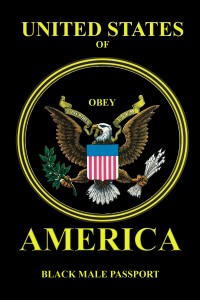
Pass-copyM. Peek Fitzgerald,
Harrisburg, PA.

In my 53 years of life I feel that I must carry something like this every time I leave my home. This is not the America I fought for. Not the America that I have to explain differences to my children. I’m an American too and I feel like a castaway in my own land.

Aggressive homogeneity hurts white folks too.

Erika Chester
South Korea

I’m an American living in South Korea, married to an American soldier stationed here. I grew up in what I recently articulated as aggressively homogeneous culture in the Midwest.

Fortuitously, I became friends with one of the very, very few students of color in my high school. Her friendship has done so much for me, and it was the first to challenge my internalized aggression and general angst toward the “other.”

Aggressive homogeneity is manifest in bullying and ostracizing, which I’ve experienced, and racism, which I haven’t. It hurts everyone it touches.

Join the Newsletter

Subscription to our newsletter open soon.

Indulge in timeless elegance with our hand-curated collection of luxury vintage men’s fashion. From classic suits to iconic accessories, our online store offers a premium shopping experience for the modern gentleman who appreciates quality and style. Shop now and elevate your wardrobe with our carefully selected pieces that celebrate the art of craftsmanship and heritage fashion.