X

White skin, still counting every dollar.

Vivian Repassy,
Westborough, MA

There is always a common assumption that being white automatically means you are financially stable and wealthy. While being white comes with some societal privileges, it does not erase financial struggles. “Counting every dollar” highlights the struggle of living paycheck to paycheck. This race card is to prove that race and class are not the same, financial stress exists across all races.

Mon Dieu! Mais vous êtes blanche!

Shari Miller
Polk City, IA

My junior year of college, I was studying abroad in Paris, France. I had joined a gym while over there, and one day as I was returning from the common shower area with just a small towel to cover me, a French woman said loudly to everyone around her: “Mon Dieu! Mais vous êtes blanche!” (A comparable translation in English would be, “My GOD, how white you are!”) She went on and on and ON telling others to look at me while asking them if they had ever seen anyone as white as I was – and asking me if I ever got out in the sun. Still to this day I can instantly return to that moment – that feeling of being nearly naked and having my skin color being examined by everyone present in the locker room…

See me not my white skin

Susanna Lee,
Roanoke, IN.

I have lived in a world of “white privilege” my entire life. I didn’t ask for it, I did nothing to earn it; my skin is white, but my blood is Cherokee Indian, French-Canadian, Mediterranean-Italian, German, and Irish. As a youth of the Reagan era, I benefited from this “white privilege”, naively. I fully reject it. I love all people, but don’t always feel this love in return because they don’t see me, they see the color of my skin – white.

Never complete, white skin, African soul

H. Allan White,
Huntersville, NC

My earliest and formative years were spent in an era of segregation and the early trials of desegregation. Despite an upbringing in the U.S. southend, I developed a keen interest in different cultures, different people…anything different. It was that interest that help instill in me wanderlust…a desire to go see what was on the other side of the world and what was just down the road. On a return from a journey to Botswana and Namibia, I read a poem from which my six words were captured.

My African Curls, Scottish White Skin

William (Bill) Roderick Wilson,
United Kingdom

Where did I get my curls ?
Growing up in Scotland in the 1950’s I was one of 5 kids in a happy rural home in Perthshire. My father was Dr William Wilson, a hospital Consultant in Perth, my mother a nurse. His father John had been a Minister in the Church of Scotland, a complete shift from what was socially expected as all previous generations had been coal miners. This was only possible because his mother, the formidable Euphemia McCulloch, determined that none of her 7 sons would go down the pits. She put them all through university with her sewing machine. My grandfather said he never went to sleep other than to the sound of his mother’s sewing machine.

We would sometimes speculate where the curls that were scattered through our family might have come from. My father’s curls were even tighter than mine. At school I was called Willy the Wog which embarrassed me as I didn’t know what a Wog was.

I had no interest in my family history, and it was only when my cousin (another John) began researching it that he came up with the fact that one ancestor, James Wilson had emigrated to the US in 1766, fought against the British in the War of Independence and signed the Declaration of Independence, becoming one of the founding fathers of the US.
John’s research also gave him an interesting idea. He was able to trace the mining Wilson’s all the way back to 1489 (several called William) because until 1833 miners in Scotland were the property of the mine owners. That made them valuable serfs or slaves, so good records were kept. If a mine owner did not own enough miners he would sometimes import slaves from Africa – so John asked ‘might this have been where our family curls came from?’

I took a DNA test and was astonished and delighted to find that my ethnicity estimate included 3.4% African (2.4% North Africa and 1.1% Nigerian). Both these are slave areas and this would be consistent with ancestors being brought across in the early 1700s.

Suddenly as a proud Scot I have even more to be proud of and if I am honest I am still trying to get my head around all that it means. However, I am glad to have the chance to give my story to The Race Card Project.
Bill Wilson June 2021
Perth, Scotland

No, I am not a foreigner.

Denise Valstar,
Netherlands

Very often people ask me where I am from. I am born in the Netherlands, my parents are born here. The only reason for my ‘not so white’ skin is my grandmother who originates from Indonesia. I’ve been asked so many times if I speak Arabic or any other African or South American language. When I tell them I am just a Dutch woman, they blink and ask me if I’m sure.

Wel.. yes. I’m pretty sure I know where I come from. Thank you.

Mzungu: Kenyans say, white skin human heart

100_1007Crystal Gregory,
Kenya.

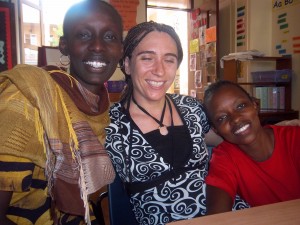
An American by birth, I live in East Africa. Here my neighbors assume because of my skin I am rich, beautiful, or have extra love to share. I offend neighbors when I refuse to have a househelper or a driver or even, really, detest having a security guard or the other ‘helpers’ white people are supposed to have. They say, after living here for a long time, that I am white on the outside and black on the inside, because, well, I don’t know. People in America act surprised when I call this place home, and ask me if I’m afraid here. I think instead, we are all people inside, each looking for our own way on this earth.

United yet unique, diverse yet connected.

Dana,
San Antonio, TX.

Around the world, my white skin and my blonde hair make me easily identifiable as an American. This superficial categorization has lead me to wish that people took the chance to get to now me for who I am, rather than making assumptions about my character. In return, I challenge myself to do the same with new people who I meet and interact with everyday.

Puerto Rican. Mexican. Caucasian. That’s me.

Carissa Renee Chacon,
Wayne State,
Detroit, MI

Born with the curliest, thickest dark brown hair (well now it’s auburn). Hazel eyes that have green and specks of gold. Skin white as snow. There’s always been a push and pull situation regarding my ethnicity. Most people don’t believe me when I say I speak Spanish fluently. No, I never took classes for Spanish. I grew up with the language. I’ve received a lot of positive and negative backlash for my mixed race. Most work places have hired me because of me being bilingual. Yet I’ve had other places not hire me because they want someone “of color” to work for them. Not someone with white skin. Yet people don’t understand that I consider myself a person “of color” even though my skin is fair. I’m Hispanic, for crying out loud. People will just look at me and make assumptions right away. I think awareness about the race card is such a great way for this to become an open space where people can just express their feelings and have open conversations. It’s not everyday where we get to talk about this or it might be considered “taboo” or “uncomfortable” to some. But so what?

Our daughters look like both of us

Heather,
CA

My husband and I have two beautiful daughters. Both of our girls have white skin, light brown hair, and brown eyes. When looking at them, others would assume they are white. My husband is Filipino/Italian and has dark skin, black hair, and brown eyes. I am white with blond hair and blue eyes. Our daughters look like both of us but took more of my traits. When we go to places, people often assume that he is not their father. There have been many times that people have asked if he adopted the girls, or bluntly asked if he is their “real dad.” It’s rude and disrespectful to our family. First, it is nobody’s business if a child has been adopted or not. Second, a “real dad” is any dad that is raising the children. Third, families come in all different colors, sizes, and parents.
CBU HIS311

Join the Newsletter

Subscription to our newsletter open soon.

Indulge in timeless elegance with our hand-curated collection of luxury vintage men’s fashion. From classic suits to iconic accessories, our online store offers a premium shopping experience for the modern gentleman who appreciates quality and style. Shop now and elevate your wardrobe with our carefully selected pieces that celebrate the art of craftsmanship and heritage fashion.