X

Your words do not offend me!

Anonymous,
Austin, TX.

With the onslaught of social media, people feel that that they can judge and pressure any and everyone into being afraid to say anything that might be considered different or something that someone may disagree with. Like the old saying, “Sticks and stones can break my bones but words will never hurt me”. Being emotionally mature means that people can listen to someone else’s words and opinions and not be offended. If you don’t like or agree what someone says just don’t listen but shaming someone into not sharing their view isn’t going to make the world a better place

Afraid to mention the colour ‘black’.

Ann Murphy,
England

I worked in a fabric store in A predominantly white, middle class city in Southern England. I myself am white Irish and have experienced racism here too. But while working, serving customers, a person of colour might come to my desk and ask my opinion on what colour might suit her project best. I was so conscious of the fact that I was serving a black woman and that colour was an issue, that I was afraid to suggest the colour ‘black’. It was no longer simply a colour but now had layers of meaning superimposed onto it.
This happened every time I found myself in that situation. Eventually I couldn’t mention black or white in case the customer took offence.
Thankfully, I overcame it! It was all my ‘stuff’ anyway. To them it was simply a colour. Nothing more!

Afraid for my Native American children.

Jarret Cummings,
Rockville, MD

My wife and children are members of the Cherokee Nation, but we have the good fortune to live in an area where they are unlikely to face discrimination. I worry about what may happen if my children ultimately go someplace where racial discrimination is still prevalent and how I should prepare them for that possibility. As a white male raised in Texas, I’ve never before had to think about racial discrimination as a personal concern as opposed to a social and political problem. Now, the thought of my wife, son, or daughter possibly having an encounter with the police has a chilling dimension to it that’s hard to process.

#EDUCAUSE2018

I am afraid of offending you.

Ellyn Ebersole,
Martinsburg, WV.

With the age of social media where it is silently stated that you have to “pick a side” in race relations I have found myself questioning why in an age of rising racial tension, do I have a hard time identifying where I stand?

I love other races. In fact, I find them fascinating. As a Caucasian mid-twenties female, I find nothing more enjoyable than learning about other cultures and appreciating them. In today’s time, it seems to be a never-ending black versus white epidemic.

I have bonded with both black men and women and have found them to be some of the most withstanding people on the planet. I love African American spunk. I love their music. I love the way they outdance white people on almost every level. I love their genius when it comes to having quick witted minds. I love their drive, their ability to still smile in awkward situations that most of us never face and most of all, I appreciate the strength of black women. I wish I had the passion, heart and love they possess.

But when it comes to talking about political issues or race relations, I feel silenced.

I feel that in normal friendships I have, I can talk about world issues and even disagree vehemently, but still be loved and regarded.

As friends, I can even disagree about life choices, attitudes and behaviors, and still keep my relationships intact.
I can criticize white people 24 hours a day. Politics, government, jails, and our community is overloaded with crooked white people that I can talk ill about, and I do.

But if I pick apart issues I have with victimization of all black men in the media who have been killed by a police officer? I am labeled a racist.
If I want to hip hop dance, I am called a person who is “appropriating black culture”.
If I want to sing a rap song, black women are okay with me singing parts of the song where we as WOMEN are objectified and sexualized as meat, yet gasp and shake their heads when I repeat the “n” word in the song.
If I want to braid my hair, then I’m accused of stealing black ideas.
Rather than viewing it as a white woman who LOVES the culture black people have introduced us to, I am now the enemy.
And once again, I am a racist.
I am trying to tell the black community that not only do I love, and appreciate you, but you give me a sense of adventure. I don’t want to steal your ideas, I want to emulate some of them. Because they are amazing.

I am afraid of offending you.
I am afraid that I will be told that I can not be against some black actions, and still love you.
I feel that I cannot disagree with people based on their actions, because if they are black, I am accused of being against their SKIN color, rather than who they are.
I am afraid that if I make a joke about black people after hearing black people joke about black AND white people all day, now I’m being “prejudiced.”
I am afraid that if I have too many white friends, that you won’t want to be friends with me.
I am afraid that maybe I am just “a little too white girl for you.”
I am ashamed to be white when black is the majority because it is a double edged sword.
If I emulate you, “that white girl just wants to be black”.
If I don’t, “that white girl doesn’t know ANYTHING about black struggles or what we have been through.”
How can I be friends with you, if I cannot disagree?

In the end, I don’t know what it’s like to be black. And you don’t know what it’s like to be white. Women have been oppressed even before black people were. And I know how it feels to be a woman. Most of all, I know what it’s like to be a HUMAN with feelings, desires and a heart.
We both have ways we can try to up each other on our histories.

But I don’t want to be friends with you because you’re black. I want to be friends with you because you are you.

But, I am afraid of offending you.

With kids, I’m dad, alone….thug!

Marc A Quarles,
Pacific Grove, CA.

Pacific Grove, I’m African-American my wife is German we have two children a son 15 and a daughter 13. We live in a predominately white affluent area on the Monterey Peninsula in California. Every summer my wife and children go to Germany to visit her parents and other friends and relatives so consequently I spend the summers alone. During the summer when I am alone I’m treated very differently people seem apprehensive to approach me and most of the time I’ve noticed my white counterparts almost avoid me. They seem afraid we’re don’t know what to think of me because I’m in their neighborhood. I often times wonder if they think I’m a thug. The same does not happen when I have the security blanket and shield of my children. When my children are with me I’m just a dad.

NPR continues a series of conversations from The Race Card Project, where thousands of people have submitted their thoughts on race and cultural identity in six words.

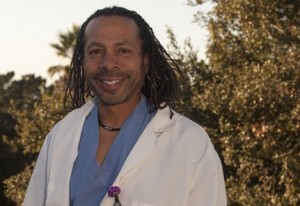
Marc Quarles is African-American, with a German wife and two biracial children — a son, 15, and daughter, 13. The family lives in Pacific Grove, a predominantly white, affluent area on California’s Monterey Peninsula.

november 2014_1960 (1)Every summer, Quarles’ wife and children go to Germany to visit family. Consequently, Quarles spends the summers alone. And without his family around, he says, he’s treated very differently.

Most of the time, “I’ve noticed my white counterparts almost avoid me. They seem afraid,” Quarles tells NPR Special Correspondent Michele Norris. “They don’t know what to think of me because I’m in their neighborhood. I oftentimes wonder if they think I’m a thug.”

“The same does not happen when I have the security blanket and shield of my children,” Quarles says. “When my children are with me, I’m just a dad. I love being a dad.”

Those experiences prompted him to share his six words with The Race Card Project: “With kids, I’m Dad; Alone, thug.”

Many people have written to The Race Card Project about how they feel people perceive them, based on their skin color.
Whites can’t distinguish Harvard from Hoodlum — Alisa Dennis, Los Angeles
Lady, I don’t want your purse — Anthony Freemont
Did you just clutch your purse? — Chima Ordu, Garrison, Md.
I was stinky; I wasn’t afraid — Lynne Shotola, Waukegan, Ill. —
Purses are clutched when I approach — Hiawatha Walker
‘Where Are You From?’

“There aren’t a whole lot of African-American males in Pacific Grove,” Quarles says. “So I think most people do wonder, ‘What is this … black guy up to? … Why is he here, and what is he doing? And why is he in my nice, affluent neighborhood?’ ”

That “stings and bites,” says Quarles, an ultrasound technician. “I have a very decent job. I would take care of most of these people if they came to my hospital. And to assume that I’m anything less than a productive member of the community, that does hurt.”

‘I’m Just A Regular Old Hospital Worker’

Quarles recalls an incident when his family first moved into their second home in Pacific Grove. “We had been in the home for maybe two days,” he says, when the police knocked on the door, looking for a missing purse.

The officer asked Quarles if he had noticed anything suspicious in the neighborhood. “And I said, ‘Like what?’ And he said, ‘Well, the woman across the street is missing her purse.’

“And I looked at him, and I said, ‘So, you can come in and look for it if you’d like. But no, I didn’t take the purse.’ ”

Quarles was surprised when his neighbor approached him a few days later. He walked over to tell Quarles that he was “really sorry about the other day.”

“And I said, ‘What do you mean?’ And he said, ‘Well, the police went over to your house.’ And I’m like, ‘You sent the police to my house?’ ”

The neighbor explained that he did ask the police to check them out, but his family eventually found the missing purse — in their own home. He then went on, Quarles recalls, to ask Quarles where he was from.

“And I said, ‘I’m from here, Pacific Grove.’ And he said, ‘No, really — where did you move from before you moved here to this house?’ ”

When Quarles explained that his family had moved from their first home, nearby, “he looked at me again and he said, ‘You have two houses?’ ” Quarles says the neighbor then looked at him from head to toe and asked, “What do you do?”

“And part of me — sometimes I mess with these people. I’ll tell them, ‘Well, I sell drugs and I’m a pimp. I can get you anything I want.’ … I say it deadpan serious.”

They finally realize he’s joking, Quarles says, when he starts laughing. “And once they see the crazy hours that I work and they see me in my hospital scrubs, then they clearly know I’m not a pimp and a drug dealer,” he says. “I’m just a regular old hospital worker.”

Living With A Double Standard

Quarles’ experiences weigh on his mind when he thinks about his children. His son, Joshua, has brown skin, while he described his daughter, Danielle, as “very, very light. She could almost pass for white.”

Quarles knows the community and the world might treat his kids differently as they grow older, particularly with one child being lighter and the other darker-skinned. “I think the world will have a certain idea of what they are, and what they can become, just by looking at them,” he says.

That difference also comes into play with how his kids see themselves, Quarles says. Several years ago, he says, his daughter’s teacher asked the class to write essays about what the Martin Luther King Jr. holiday meant to them.

In her essay, Quarles’ daughter wrote “that if it were not for Dr. Martin Luther King, she and her brother, Joshua, would have to go to different schools,” Quarles says.

“She meant that she would go to one school, and that her brother, Joshua, because of his browner skin, would have to go to a school other than the school that she attended.”

Quarles and his wife wrestled with if, and how, the family should discuss the issue of skin color together.

In the end, he says, “we decided to … let her grow and potentially approach that conversation a little bit later. Because I think eventually, and unfortunately, someone who’s a little lighter than she is with a little straighter hair, with a little blonder hair, is going to call her out and get her to understand that she does have some brown in her.”

Even so, Quarles says, “I don’t know if my wife and I are doing the right things by not talking about race that much with them.”

But as their children get older, they’re the ones who are bringing it up — like this summer, after a white police officer shot black 18-year-old Michael Brown in Ferguson, Mo.

Quarles says his son “brought it up many times, and continues to bring it up. Because he identifies with being more black than white, although he’s split right down the middle. And things like that do concern him.

“As he’s getting older, he’s getting bigger and stronger and folks are starting to wonder about him,” Quarles adds. “You know, ‘What is he? Why is he here?’ ”

Quarles responds by telling his son “that there are simply things that he cannot do,” he says. “Just because of his appearance and his brown skin, there are things that he can’t do that the other kids can do.”

And if that sounds like a double-standard, Quarles says, that’s because it is. “That’s my answer: ‘It is a double standard, Son. And trust me, one day, you’ll understand.’ ”

Not that Quarles accepts double standards based on skin color. But he’s had to figure out how to rise above them, he says — how to succeed by letting certain slights go. And that’s the path to success for his son, too, he says.

“You can live in this world with that double standard and be successful and have a wonderful life.”

It was just not talked about.

Debra Miller,
Rochester, MN

Our mother hid our Native American ancestry until I was a late teen. I was raised in an area that continually brow beat and bashed Native Americans and I was afraid to tell anyone about my bloodlines back in the 70s. As I aged I realized it was OK to be proud of our heritage instead of embarrassed and I now openly share that side of me even tho I really know too little about the people before me because “it just wasn’t talked about”. My mother painted the photo I attached showing her vision of Native American art as she saw it.

Why are we afraid of TRUTH?

IMG_0812C. Denise Johnson
Pittsburgh, PA

TRUTH is… we are all part of the collateral damage of institutional racism. That’s why some of us are resistant to change and others want more change. When the foundation of your society is predicated by elitism, sexism and racism, you end up with a schizophrenic nation afraid to look itself in the mirror.

Mother’s warnings at four, instilled racism.

Carmen Davis
Portland, OR

I was a very young child from the Midwest traveling with my mother by train to Detroit in the 1940’s. There was an African American couple on the train with a wonderfully packed picnic basket.

As a very gregarious child I was eager to explore the car. My mother told me it was okay to go visiting unless the man was there alone, because he would slit my throat with a razor.

I didn’t even know what that meant, but I knew I should be afraid.

Anymore, afraid of what we represent.

Photobooth11M.W.,
Brooklyn, NY.

We have been in our neighborhood for coming on ten years and in that time it has changed from ‘Bed-Stuy’ to ‘Clinton-Hill’ to ‘Fort Green East’ as the realtors slowly remade and gentrified neighborhoods. Each economic surge carved out new districts and displaced our neighbors. The most recent insurgence of peoples have been of my skin color, young and upwardly mobile. I just recently witnessed a very peppy white woman greeting an equally perky white woman at Nostrand Ave (six months ago, unheard of), ‘Lisa, is that you? Yeeeah! What are you (italics added) doing here?!!!? I just move here a week ago.’ All this as I walked down Fulton Street to my home thinking ‘is that what people see in me? ‘

Whites afraid of becoming the minority

Tyler,
CA.

If there’s one thing I’ve observed in my life that pertains to the current state of racial prejudice in this country, it’s that the prevailing fuel for white people’s racism is their fear of the possibility that they might finally become less than the majority. With two white parents, as kind as they are, little phrases have always popped up that appear to have racist roots. Things like mentioning the statistics on how many children the middle eastern families have, and how fast their numbers are growing as a result. Obviously not felt by all, but the fear of not being the majority seems to be what drives a large amount of today’s racism.

CBU HIS311

ALL colors should obey the laws.

Donna Corrigan,
Bloomingdale, IL.

People would not be so afraid of the changes happening with racial imbalance in our country if laws weren’t being broken, people weren’t coming illegally, committing crimes, selling drugs. Of course it’s not everyone! But there are make people afraid and that’s enough to cause prejudice. Fear promotes anger. Anger promotes bad behavior . . . . by everyone.

Race: no reason to be afraid.

Sam Kadish,
Newton, MA.

Race is incredibly important to our history. It should be a sidebar in our future. America is the great melting pot; too many people have stopped being proud of that. Race should add color to life; it should add life to culture. America will eventually fail if race remains the first way we judge others. The reality we live in, need not be the reality for our grandchildren. Our personalities, charity, economic realities, heritage and abilities should define us, not the color of our skin. We should be able to joke about each other’s races without fearing deep insult. If brown people have taken over half the businesses on Main Street, it should be an observation: I’m sad that bob’s barbershop is gone but you are happy about the great burrito joint next door. It need not make any body nervous that more names on this years baseball cards are latino. We are changing; get over it.

Join the Newsletter

Subscription to our newsletter open soon.

Indulge in timeless elegance with our hand-curated collection of luxury vintage men’s fashion. From classic suits to iconic accessories, our online store offers a premium shopping experience for the modern gentleman who appreciates quality and style. Shop now and elevate your wardrobe with our carefully selected pieces that celebrate the art of craftsmanship and heritage fashion.