X

A reflection of my ancestors’ sacrifices

Elizabeth Franklin,
St. Louis, MO

I’m from St. Louis, MO, but I currently attend Dillard University in New Orleans, LA. My family has always been adamant about recognizing the sacrifices and struggles my ancestors had to go through for us to be in the positions we are in today. That includes learning and appreciating our history and emphasizing education and other opportunities to take advantage of what our ancestors legally could not.

My Ancestors Bones Not For Museum

remains-of-chero-nottowaySonya Williams,
Baltimore, MD.

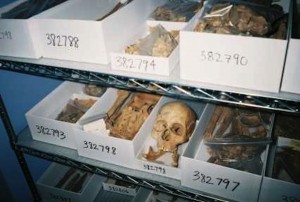
I grew up in a unique area of North Carolina in what is referred to as a ti-racial community. My Indian family are the Cheroenhaka Nottoway and Meherrin Indians of Southeast, VA & North Eastern, NC. When I went to college, during a lecture in my anthropology class, the professor was discussing a dig that took place on the Nottoway River and how 193 bodies were removed and placed in the Smithsonian collection. After the class, I approached the professor and told her I was a member of this tribe, but had never heard about this. This was in 1985 and that knowledge has haunted me every since. I contacted the museum on many occasions and was told by staff that “the Smithsonian does not house human remains.”

I new this wasn’t true, but I had no legal way to get to the information. This went on until President Clinton enacted the, Native American Graves Protection and Repatriation Act, which forced institutions to return all Native American artifacts and burial remains. After this, the museum did in fact admit to having the bones; however, they will not turn them over to the tribe because the act only covered federally recognized tribes, not state recognized. Therefore, we still wait for our ancestors to be returned to their eternal rest which is promised to all by God, but is being denied to my people. I am currently writing a book to bring attention to this injustice. Not to promote hate of any race, but in hopes that everyone black, white, red, or yellow, can agree that no human remains should be held in museum cases.

Thank you for doing this project. I have so enjoyed the stories. It was hard for me to pick just 6 words. I have many 6 word stories I can tell; being of a multi-race background.

Bon Appetite! Italian food- who I am

Sydney,
Baltimore, MD

Being Italian makes up a big part of who I am. My Italian Great Grandmother who I call my Nona has taught me that food is so much more than something to eat. My Nona takes pride in each step of making a meal, even the not-so-fun parts such as the cleaning. The love she puts into her cooking has made me appreciate my Italian heritage.

Nobody talks about my ancestors struggle.

Anonymous,
USA

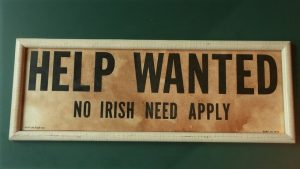
I’m the great-grandson of Irish immigrants who came to this country to escape famine, persecution, and poverty. However, nobody seems to talk or care anymore about the struggles they faced when they arrived in the New World. My people were excluded from public life, forced into menial labor, and refused the same Constitutional protections as their White Anglo-Saxon Protestant neighbors. I mentioned this on a message board recently and was told I’m a “racist” and that I “probably have an Irish and Confederate flag in my yard” when bringing this up because Irish-American People were “allowed to assimilate unlike African-Americans”. Go to South Boston or Queens and then talk to me about “assimilation”. These folks continue to have their own unique cultural heritage and, despite disparaging remarks from others, the fact is that the Irish have helped make this country stronger, safer, and more prosperous. Our history should be celebrated not categorized as “racist”.

Rooted in Hatred, Risen in Audacity

Ellis Clark,
Spain.

As a seventeen-year-old black male, my view to race has been cushioned by growing up in a comfortable, yet politically aware household. While I knew racism existed, it rarely touched me growing up, and when it did, it was the microagressive type. Real issues with race didn’t begin to pop up for me until middle school, and my view on race is now that it is an important part of my identity, regardless of the tribulations that people attach to it. I wouldn’t be who I am without being black, and the thought of not being black is one that never crosses my mind. Although I struggle sometimes with the implications of my race, I think of the feats my ancestors overcame with grace and know that my life today is impossible without the fighting sacrifices they made for me. Rooted in hatred as it may be, my race is risen on account of the audacity of those before us. We owe it to them to continue on with their torch to the mountaintop.

Stereotypes are a result of laziness

Christal L,
Wayne State,
Detroit, MI

Instead of getting to know people, some find it easier to put people into boxes. Black = bad. White = good. Mexican = illegal, etc. It’s sad. Get to know people. Skin color gives a hint to who a persons ancestors could have been. It says nothing about the persons character.

We are not what we were

11846786_10204781951934066_7035223788531737507_nKellianne Murtha,
Chesapeake, VA.

Times have changed, people have changed so why is “race” still thought to be an ongoing problem? We are no longer who our ancestors were and we no longer believe all of which they did. Race should not be a problem and should not be a deciding factor for things, such as jobs or scholarships. We are all equal and we should ALL be treated that way.

Just want credit it is due.

Jasmine Shabazz,
Beachwood, Ohio.

So, never once have I blamed the white kids and there families for slavery. Never once did I say there ancestors enslaved mine. And I hate to look like the girl who always plays the race card, or who always wants to cry about the struggles my ancestors went through. But when I feel like my struggle is being downplayed or overlooked I can’t help but too speak out. And to my peers it may seem like I’m always speaking, but that’s the result of being more than one minority. My mother is Puerto rican and black, My father is Saudi Arabian and black. Highly unfavored! And I would never put my struggle over anyone else’s but at my school it is a high concentration of Jewish people and its so amazing to me too see there culture thrive and how tight knit the community is. And so when you sit in a class of kids that are mainly Jewish it seems at times that there struggle is being put over mine. And that doesn’t go down easy for me because after there oppression they bounced back and I commend there community for being so strong. But my people are still so broken that we can’t seem to get ahead and this kills me because I wish after our culture has been erased and we have been stepped on that we can come back and unify and show how magic us ” Blacks” really are. But in 2016 it seems impossible. SO I’m sorry if this has offended anyone but I can’t hold my tongue when it comes to defending and representing my ancestors. I accept there struggle as my own and it will not be forgotten until the pain is.

The fiction of whiteness imperils humanity.

Evan Sorem,
San Diego, CA.

I am a human being. I have lived nearly all my life in California. My ancestors have lived in California, Illinois, Wyoming, Utah, Tennessee, Virginia, Norway, France, Italy, England, the Netherlands and who knows where else. So, people view me as a “white” person.

In my 40’s, I have learned that there is nothing inherent in me to support the notion that I am a “white” person. So, I am now rejecting the label. I am a person. My children are people. My friend, who I heard called a “n*****” by kids driving by in a truck as we walked to his house, is a person too. The humanity of that friend is constantly in danger because of the perception of the kids in that truck that they are white and he is not. But they are not white people. They are people. As is he.

As was Trayvon Martin. As was Michael Brown. As was Eric Garner. As was Tamir Rice. As was Walter Scott…..

If we cannot act to destroy white supremacy. White supremacy will destroy us.

I’m an Arab named Dave Hall

Arab nameDave Hall,
Brooklyn, NY.

I get my name from my Yankee (English-American) father, whose ancestors arrived in Boston in 1630 but I get my complexion from my Arab-American mother. People do a double take when they first meet me after only hearing my voice on the phone. And new friends quickly learn that I am passionately insistent about discussing Arabs in truth, not in myth and stereotype.

Who are your ancestors. Be honest.

Eliza-Jan-Van-Mater-Van-DornAlison Bailey,
Bloomington, IL.

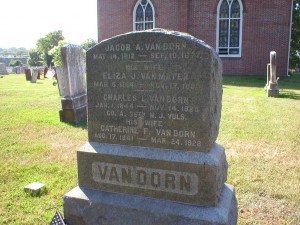
Yes. I’ve been able to find out who my 3d greatgrandmother is until recently. She was the bastard child of Joseph C. Van Mater, or “Big Joe,” as he was called. The Van Mater family were early settlers in Monmouth County, New Jersey. Big Joe was the largest slave holder north of the Mason Dixon line. He own almost 100 people. His story is mind-boggling, and almost forgotten. I’ve summarized it below.

Eliza Jane Van Mater: Joseph van Mater’s Illegitimate Daughter?
I want to start my story with Eliza Jane because her life, until recently, was a mystery to me. Her grave is marked with an ostentatious headstone, yet the pedigree trail for Louisa’s mother immediately dead ends. Her last name is the only clue to her past. The Van Maters were among the earliest families to settle in Monmouth County, but she does not show up in any of the family trees. We don’t know much about her, but in this case, the backstory is more interesting, and worth telling.

At the age of seven, Joseph Van Mater leaves Eliza Jane the extraordinary sum of $7000 in his will, but the family relationship between the two is not made clear in the will, probated on 20 January, 1821. As one of the most wealthy men in the region, “Big Joe,” as he was called, had an immense amount of property to dispose of upon his death. His first and only wife, Catherine, died 11 months after they were married, and he is reported to be so grief stricken that her never remarried. He gives his land and most of his slaves, furniture and household items and money to immediate family members, and without reference to any family:“To Eliza Jane Van Mater, £1,400.” Eliza is listed in the orphan’s index. The citation reads: “VANMATER; Jan 1833. Eliza Jane VanMater, a minor over 14 yrs, and a legatee of Joseph VanMater, dec’d elected Joseph H. VanMater and Holmes VanMater as her guardians. One charitable reading is that, Eliza was an orphan Van Mater took to kindly, she took his name and at some point elected Joseph H. Van Mater and Holmes Van Mater to be her guardians. However, it was more likely that she was his illegitimate daughter and he saw to it to leave her a large dowry.

Joseph H. and Holmes [I think they were second cousins] were the appointed executors to administer his estate to take care of all of his ‘orphans’, including his “black family, or the black people that have belonged to my family.” George C. Beekman’s book, Early Dutch Settlers of Monmouth County (1919), includes a copy of “Big Joe’s” will, and tells the following story:

A story has been current for some two generations, among the farmers of Holmdel and Atlantic townships, that “Big Joe” VanMater, childless and wife- less, wanted to own an even 100 adult slaves, but although he made many efforts, yet when he reached this number, some accident or fatality would happen, which would cut down his “human chattels” to ninety and nine. As it was, he had more than he knew what to do with. After his death they were all set free, as directed by his will. Many of them by years of dependence for food, clothing and shelter on their easy going, good-natured master, were like children, unable to take care of themselves [sic]. Neither were they content with a new place of abode. They clung to their old home.

It is said that after “Big Joe’s” death the road from what is now the Phalanx to Colts Neck, was black with these newly freed negroes, and they wandered back and forth, perplexed and bewildered with the great change. For it was hard to find another home, where the “black people” would be treated as part of the family, and where there was another man, like lonely, but good-natured and generous-hearted “Big Joe” VanMater.

Many of them sought homes and shelter from Joseph H. and Holmes VanMater, the devisees and legatees of the deceased. For in his will he strictly charges them to take care of the “black people of my family” and “those which had belonged to the family.” This brought upon these two men, all the helpless and indigent ones of this estate, as well as those of their grandfather and father.

There are people….who remember Joseph H. VanMater when he drove over to church at Holmdel on Sundays. Not only his immediate family, but crowded in with the whites, in a big carryall, would be all the colored people who wished to go to church. This burden of the negroes, together with heavy legacies charged in the will of “Big Joe” made a heavy financial load for his devisees to carry. For the land brought in no income except as farmed and the profits were then small.

Caring for so many proved to be costly, and I’m guessing that executors were forced as some point to sell his land. Members of a new utopian community “The North American Phalanx,” the largest and most successful of some 28 communes found in the United States in the 1830s and 1840s purchased VanMater’s estate for their new social experiment. When they moved in they found a number of free Blacks living on the old plantation and simply evicted them.

Sources: Graham Russell Hodges, Slavery and Freedom in the Rural North:African Americans in Monmouth. Oxford, U.K: Madison House (1996); George C. Beekman, Early Dutch Settlers of Monmouth County. Freehold, NJ:Moreau Brothers Publishers, 1919; Judith B. Cronk, Intestates and Orders from The Orphan Court Books of Monmounth County, New Jersey, 1785-1906. Baltimore, MD: Clearfield Company, Inc. (2002).

Cajun heritage and worked for everything

ThinkingFeldon Starns,
Summerville, SC.

I come from a lower middle class family. I was the first to graduate collage in my family. I worked full time at menial jobs and paid for everything myself. No loans, grants, scholarships, or aid. Nothing was given to me. If working inside old fuel tanks in a shipyard is “privilege” then so be it. However I did what it took to better myself and have no guilt about the color of my skin what so ever.

I can only shake my head at the attitudes of so many people these days and times. They believe because their ancestors had a hard time and suffered that they deserve special treatment or I for that matter should feel bad about who I am and where I came from. Well here’s a check for you; life isn’t fair, and everybody had a hard time of it in this country. Admittedly some worse than others, but you can bet if you look close enough you would see the truth in this statement.

My father as a small child had the Klu Klux Klan burn a cross in his yard. Why? He was white? Because he spoke French, was catholic, and my grandfather ran a saloon. He was beaten by his teachers for not speaking English in school. He had it rough even after he left Louisiana. But he worked hard and believed in this country. That’s what he taught his children to do also.

In the 1970’s I had long hair and black friends. I wish I had a dollar for every time the cops pulled me over and tore my car apart looking for drugs or contraband. I’ve been not waited on in restaurants because of how I looked, called names and treated badly by people of all colors. So I really have a hard time with people who walk around talking about this or that, then expecting me to feel bad or guilty about who I am and where I’m from.

My ancestors were put into slavery by the British. Those that were able to make it to New Orleans where shunned by the Creoles, and the white population. They were pushed west into the swamps and bayous to the land no one wanted. There they built a solid foundation and thriving culture with help from no one.

So the next time you want to throw out that life is not fair to you because of the color of your skin remember that every group has had their problems. And to the people of all colors and creeds who hate or think the world owes them something, get a life.

I’m Me, You’re You, Both Beautiful

Mary Engleman,
Tacoma, WA

I get told all the time I must be racist because of my heritage. But you don’t know my heritage. I don’t happen to look like my ancestry (Hmm, wonder what that could be from? Could I be two different races for some reason? Think hard.) I didn’t get to choose my ancestors any more than you got to choose yours. Pretending you know all about someone because of their physical characteristics or where you think they came from is just wrong no matter who does it. If you want to judge anyone, do it by their character and actions, not by their ancestors or their appearance.

Things I’m sick of PoC saying

Yuki,
Ft. Myers, FL.

Hear me out here. I am so sick of people talking bad about me being white, like oh I’m sorry Jaiana that I was born with hardly melanin just burn me at the stake and call me a KKK member, but that’s totally fine right? Black people cant be racist!
Okay listen up. My ancestors may have kept you, hurt you, stole your land. But do not think we are like that. Can I say how many times one of your people have came up me and called me a damn disgrace for being a white person? Once a little girl came up to me during a carnival and told ms I was going to hell because of what my race did. I DID NOT ASK TO BE THIS COLOR STOP ACTING LIKE WE DID.
IT IS NOT MY FAULT YOUR CHILD JUST SHOT SOMEONE
IT IS NOT MY FAULT YOUR PEOPLE WERE ENSLAVED
STOP
ACTING
LIKE
IT
IS

Join the Newsletter

Subscription to our newsletter open soon.

Indulge in timeless elegance with our hand-curated collection of luxury vintage men’s fashion. From classic suits to iconic accessories, our online store offers a premium shopping experience for the modern gentleman who appreciates quality and style. Shop now and elevate your wardrobe with our carefully selected pieces that celebrate the art of craftsmanship and heritage fashion.