X

Breaking news: I am not rich

Brooke Evans,
Santa Barbara, CA

I am white with blonde hair and blue eyes and I grew up in Santa Barbara, which is a fairly wealthy town. Because of how I look and where I am from, people assume I am very wealthy, which is not the case. My family has always struggled with money and it has been a huge issue ever since I can remember that has caused many fights between my parents. I also attend a private school with an expensive tuition, so this adds to people’s assumption that my family and I have money. However what people don’t know is that I am attending school entirely on scholarships and student loans because my parents could not afford to pay for my education. The town that my college is in is also very republican, so people think that I am a conservative, although I am very liberal. Despite this, I know that I am very privileged in so many ways because I am cisgender, straight, and white. I am also very much aware that many people have it a lot worse than me money wise and the assumptions people make about me are far less harmful than the assumptions made about people of color or people in other minority groups. It does at times get frustrating when people assume I am a rich republican because that is the complete opposite of who I am.
-Brooke Evans

Chicano/Native-American trying to recapture my past

Joseph Velasco,
Santa Barbara, CA

My brother and I have been a quest for most of our lives to try and understand our family stories in the context of what it means to be “American.” As a person of color, I am reminded by some that I am other. But as a Chicano and Akimel O’odham (Pima), I sometimes still struggle to find my place. But as a teacher, I try and empower students to have these conversations and create their own space.

How much do they pay you?

MD-Mothersday2006Rosa-Maria Lazarovits,
Santa Barbara, CA.

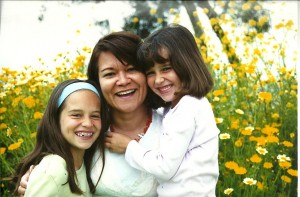
This happened when my girls were toddlers and we played at a park. A latino woman approached me and asked in Spanish: “How much do they pay you?” Assuming I was employed as a nanny. She gasped when I quickly replied: “nothing!” She could not conceive these beautiful, fair skin girls were my daughters. A long standing idea of a “malinchista,” a traitor. A malinche is one who marries an outsider. La Malinche was Hernan Cortez’ translator, Mexico’s conquistador, with a horrible tradition as someone who gave up on his own roots, betraying his people, but history shows us that is not quiet true. She was a professional woman, with an incredible talent for languages, learning Spanish very quickly. She is the mother of the first mixed children. She is the mother of our future world, an amalgam between new and old, a native mother and a Spaniard father. Unfortunately, the clueless, woman at the park sees other Latina women as maids, nannies, caregivers. Like Malinche, I am a professional, I hold a master’s degree.

But I’m European American NOT white.

K. Lynn
Santa Barbara, CA

I do national survey work. I read the question: Are you latino or of hispanic origin? A respondent will say, “Yes, I’m Mexican American.” And then I read: “For this survey, hispanic origins are not races. What is your race?” They are asked to choose from a printed list of options: white, black, asian, pacific islander, native american. Often, a respondent will look irritated or puzzled or just tired and say something like, “Well, white I guess.” On my computer screen, there is a check box for Other and a place to write in an alternative race. I’m not supposed to share this with respondents unless they voluntarily offer an unlisted response. But sometimes as they are pondering over the list, clearly in discomfort, I’ll say, “I can also record an answer that isn’t on the list, if you’d like. Or you don’t have to answer.” Very often when I ask about ethnic origin people will respond quickly and with pride. They may choose many different origins to reflect their heritage. But often when I ask about race that wonderful sharing of identity stops. I wish I didn’t have to record race, and that government could help lead the way toward a new way of relating to each other by not politicizing race through it’s many policies, though it’s official language, through it’s survey questions. The census did try to remove race and replace it with ethnic origin a couple decades back, but race means votes and power to Washington politicians. If we stopped describing people in terms of color or appearance, what might change from that?

You think I’m Black. I’m not.

Omari N.F.
Santa Barbara, CA

Race is something we made up and nothing good has come of it (valiant struggles to overcome its many ills notwithstanding). 20 years ago I’d have been called Negro, 40 years ago ‘Colored’ and today Black. Truth is I am none of the above. There’s only one race, human. My problem with race is all the connotations and baggage that comes with it. If I’m Black I’m ‘supposed’ to talk a certain way. For many people, Black is synonymous with poor, ghetto, dangerous. Again, I’m none of the above. Just as we’ve evolved so it’s no longer appropriate to call me a nigger, someday it will no longer be okay to call me Black. If you want to know what I look like or where my ancestors were from, I’ll gladly tell you I’m a person of African decent. But let’s move away from these loaded, sloppy, insidious categories we call race.

Join the Newsletter

Subscription to our newsletter open soon.

Indulge in timeless elegance with our hand-curated collection of luxury vintage men’s fashion. From classic suits to iconic accessories, our online store offers a premium shopping experience for the modern gentleman who appreciates quality and style. Shop now and elevate your wardrobe with our carefully selected pieces that celebrate the art of craftsmanship and heritage fashion.