X

“Are they yours? Are you sure?”

Adam Conner
Washington, DC

My sister and I are both adopted from South Korea. Our parents are white. One of my memories from childhood is being at the grocery store and constantly having people ask my mom “Are they yours?” point to my sister and me. I remember one time someone then adding “Are you sure?” As if my mom was going to look over and realize then that “whoa these kids are asian! thank you stranger in a grocery store for pointing that out to me!”

“Are they yours? Are you sure?”

Adam Conner
Washington, DC

My sister and I are both adopted from South Korea. Our parents are white. One of my memories from childhood is being at the grocery store and constantly having people ask my mom “Are they yours?” point to my sister and me. I remember one time someone then adding “Are you sure?” As if my mom was going to look over and realize then that “whoa these kids are asian! thank you stranger in a grocery store for pointing that out to me!”

My brother doesn’t look like me

Caroline Foster,
Brooklyn, NY

I’m white, my younger brother was adopted from South Korea when I was five. I forget that we don’t look related because although I remember picking him up from the airport with my family, we’ve been siblings since before I understood that his experience being adopted by a white family in America would be different than mine. Sometimes I need to clarify that he’s my brother to friends or acquaintances because it’s not immediately obvious. I used to have a picture of him as my lock screen on my phone. People would always ask me if he was my boyfriend. I always wonder how he feels about it. We don’t talk about it much as a family.

Yes, that is my real name.

DSCF0480Hyosim Nancy Collins,
Beaverton, OR.

My middle name is Nancy. I was born in South Korea and arrived in the United States when I was 4 years old with my Korean family. Soon after we arrived in California, my father decided we should all have “American” names. When I became a Naturalized Citizen at the age of 18, I kept my “Korean” first name and made my adopted “American” middle name official during the naturalization process. People invariably ask if Nancy is my real name when I introduce myself or am introduced. I had and continue to notice that my friends who are of different “races” have not been/are asked the same question…

Take away skin bag, spirit lives!

Aku Kadogo, teacher
South Korea

I am an African American woman from Detroit, MI. I have lived in Australia since 1978. My daughter is African American Australia (Caucasian father). My grand daughter’s father is from Thailand. I am currently living and teaching in S. Korea. I have spent many years with Indigenous people in Australia, who strongly helped me move forward on race issues and to embrace spirit. Power to your project.

You two are such good people.

DSCF0933Erin Morris,
Tempe, AZ.

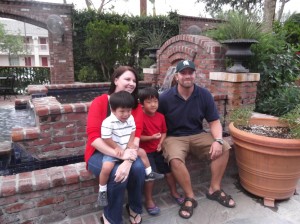
My husband and I have two sons adopted from S. Korea. When people feel compelled to mention our race difference or the obvious fact that our children are adopted, it is often along the lines of what “good people” we are, or how “lucky” our children are to have been adopted and brought to the U.S. This line of reasoning disgusts me. The world is overpopulated and there are children sitting in foster care and orphanages around the world who have little to no chance of having a supportive family structure.

Yet, many Americans spend years and tens of thousands of dollars to conceive babies that are genetic matches to themselves through a variety of unnatural medical procedures. No news story on infertility, IVF, clomid, or surregacy should be complete without mention of the other option to becoming a parent: adoption. It is unfortunate that people who face infertility by adopting their children should be viewed as “such good people”.

Always Less Than The White Girl

8647_stdDanielle Cuddy,
Napa, CA.

Growing up as an adopted South Korean female in the city of Napa proved a challenging adolescence. I was called, “China Girl” in elementary school, but that was okay with me because the other children would come to realize that they were wrong and I was actually from the opposite side of the continent. My high school graduating class was comprised of 1.9% asians, and when my date cancelled on me for my senior prom, I turned to a friend from the local private school. “But you are asian,” my friend said, “Guys at Justin Siena only like white girls.” I will never forget that. In 2014 I moved to Honolulu, Hawaii at the age of nineteen years old. I started dating a guy in the army, only to be broken up with because at the end of the day, I was not what he was looking for. He was looking for a white girl. This taught me that racism is apparent in diverse cities, as well as in small towns. Even in the present day, I hear the snickers of “Chinita” and “Konichiwa” under my latino coworkers’ breath as I pass by them in the restaurant. As a child, Hollywood gave me the role models of figure skater Kristy Yamaguchi and Disney’s Mulan. As a country, we are taking small steps in the integration of cultures to diminish racism, and I could not be more excited. However, where is the change for asian culture? I do not want any asian girl to grow up the way I did, thinking that she is less than the white girl because she is not pretty enough. I now know that I am beautiful regardless of what others tell me, but I had to get to this point by myself.

Not White But My Skin Is.

Johnny Vae
South Korea

Sometimes it sucks to be a “white” male. Especially when you’re ethnically 1/4 Native American, which I’m told means I’m more Native American than most. My life was hard growing up, so much so that even my closest friends don’t know about it. My father was a criminal who hid under an alias to avoid the FBI and we had to flee the state where I was born when I was just 2 years old because he had owed some dangerous people money–the kind of people who wouldn’t think twice about erasing his whole family.

I don’t even like writing my life as a sob story. At this point, all the adversity I faced has made me a strong person, but it still pains me that there are conversations I am not “allowed” to have simply because of my skin color. I recently started hearing about this “white privilege” thing and all I wonder is when and how I missed that train. Nothing in my life has ever been easier because of my skin color, and I get quite upset when it’s suggested otherwise. My mother worked 13 hours a day, sometimes 7 days a week after she threw my dad out to make sure that we, her sons, didn’t know we were poor. Most of my college was paid for by financial aid because my mom made less than 20k a year and she was a single mother. Not because I was white, but because I was poor. The rest I took out in loans, which I am still paying back. I chose, maybe out of foolish pride, not to claim my Native American ancestry because I don’t want that fact to weaken the hard work I’ve done to be where I’m at now. That and I’m still not sure I trust my dad enough to believe him, even though a decade of searching for records about his mother has turned up nothing to prove or disprove his claim. Either way, that’s how I was raised.

I live in South Korea now where I have a job I’m not qualified for simply because I asked for the chance to prove my worth, and someone listened. Given the chance, I made certain that I proved my ability. No part of my life has been easier because of my skin color. Nothing I have ever done has been made easier by my skin color. I’ve failed and I’ve succeeded, purely based on my own efforts, and it pains me that so many People of Color can’t see the disservice they do to themselves and others when they ask for understanding without giving it. I grew up on multi-racial carpentry crews, working alongside Hispanics and black men who were more like family to me than some of my own blood. Mine was the only white family in a middle class black neighborhood for years, and my mom was routinely pulled over by the police because the only reason a white person would be in that area was to buy drugs.

In short, don’t judge a person by their skin, no matter what color it is. It’s petty and divisive and you might be shocked to find out that no skin color precludes someone from a terrible life. I turned my around with my own effort.

Aggressive homogeneity hurts white folks too.

Erika Chester
South Korea

I’m an American living in South Korea, married to an American soldier stationed here. I grew up in what I recently articulated as aggressively homogeneous culture in the Midwest.

Fortuitously, I became friends with one of the very, very few students of color in my high school. Her friendship has done so much for me, and it was the first to challenge my internalized aggression and general angst toward the “other.”

Aggressive homogeneity is manifest in bullying and ostracizing, which I’ve experienced, and racism, which I haven’t. It hurts everyone it touches.

Join the Newsletter

Subscription to our newsletter open soon.

Indulge in timeless elegance with our hand-curated collection of luxury vintage men’s fashion. From classic suits to iconic accessories, our online store offers a premium shopping experience for the modern gentleman who appreciates quality and style. Shop now and elevate your wardrobe with our carefully selected pieces that celebrate the art of craftsmanship and heritage fashion.