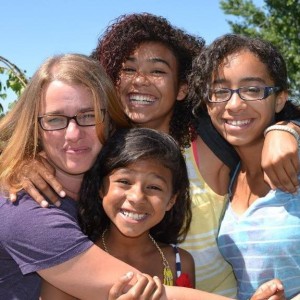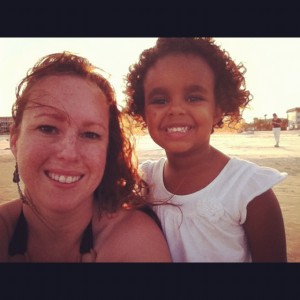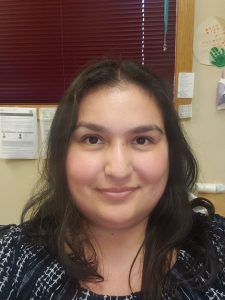
I’m their mom, not the nanny.
Allison A,
Yakima, WA.
Sometimes it’s nanny, sometimes it’s babysitter or neighbor, but being asked if I was their grandmother was a first for me. At times, the question is about adoption . . . “Where did you get her?” The questions come from complete strangers, usually white people. The need to figure out this “puzzle,” and what a white woman is doing at the store (insert anywhere public here) with these children is tangible. Maybe they can’t imagine themselves with three bi-racial daughters and want to know more. For the most part, these interactions are not malicious, it’s more out of “polite” curiosity.
Knowledge and Opinion Aren’t the Same
Krissy,
Marysville, WA
Developing a critical social justice lens requires constant study and practice. There is a lot of misinformation around social justice issues, and the majority of that information is based in opinion. While it’s important to reflect and discover how we feel about something, one has to dig deep and really consider if they are qualified to speak about an issue or reiterate information that they have received.
Once had dreadlocks. Now know better.
Susan Tsoglin
Seattle, WA
At the time, I was a white female college student in a mainly white university. Following the disaster that was the reaction to NineEleven, I became more political. I became involved in protests and rallies, doing educational flash mobs, being “alternative.” I was surrounded by white hippie culture, which had re-appropriated dreadlocks from other ethnic groups cause it looked cool. So, to follow suit, I had my hair locked (which wasn’t easy, let me tell ya). It was only after I took a class on whiteness, privilege, and isms, that I understood why dreadlocks did not belong on my white head.
Read More
The History of Dreadlocks
Illusion. We all come from Summeria
Erin Morrison
Spokane, WA
The cradle of life has no race
Queer and Pakistani. Not a contradiction
Aleenah Ansari,
Seattle, WA
I didn’t choose to be queer, but I can choose to live authentically, to stoke conversations about queerness in communities of color, approaching the dialogue with empathy, without judgment, and with respect for people, beliefs and experiences that differ from my own.
I haven’t always known how to talk about my identity, and maybe you don’t know how to have this conversation with folks from the LGBTQ+ community, either. Here’s my ask: Continue to learn and challenge your assumptions. I’ll be doing the same, while proudly celebrating all the different aspects of my identity.
Imagine yourself walking in their shoes.
Robin Smiley,
Kirkland, WA
I’m a 74-year-old white female. I was born in California and mostly raised in the Seattle area. I taught school in Meridian, Mississippi in 1975 when my husband was stationed at the Naval Air base in Meridian. I was astounded by the racism of other white teachers in a predominately black elementary school.
Best Audio Book Selection The Seattle Times
Many of us are carelessly taught.
Nate Martin,
Port Angeles, WA
Rogers and Hammerstein posited “You’ve Got To Be Carefully Taught,” and this certainly applies to blatant, flagrant hatred. But the perniciousness is also perpetuated by myriad subtle and not-so-subtle cues passed along by those of us in the privileged caste, absorbed like the air we breathe and inflicted subconsciously on those who are choked-off in that system — the implicit bias and stereotype biases, accompanied by systemic and personal denial that results in such delusions as the “this is not a racist country” and “I can’t be a racist because I have black friends” phenomena.
From the shadows into the light
Dulce K Struthers,
Mount Vernon, WA
I grew up undocumented and am still unlearning my behavior and ways of thinking to not draw attention to myself or my family.
Indian who was clueless about race
Charuta Apte,
Sammamish, WA.
I am an Indian, and teach in a under-served community in a school which is equally white, black and hispanic. In the beginning, it was a recipe for disaster. Now, it feels empowering. Just last week, I had a few student accuse me of going easy on a girl who they think is white but who is actually 75% hispanic, and I said “I’m not black, white or hispanic, so don’t bring race into this classroom”. When I said it, it felt like so many students breathed a sigh of relief. That really put a smile on my face.
Asian: Discounted everywhere but HR reports
My experience
Seattle, WA
People say “reassuring” discounting things like “I never think of Asians as people of color, you’re like white people with funny eyes.” and operate using stereotypical assumptions believing they are operating “color-blind”. In most workplaces recognition of racial diversity is limited to certain days of celebration and when it makes HR reports look good.
Authentically me, a clash of cultures.
Isabella Le,
Seattle, WA
Born in the United States, the body of three different cultures that continue to clash with each. Feeling more Vietnamese one day, Chinese another day, and American one day. Never just one, but a walking fusion of all three.
BE SOMEONE THAT CARES FOR EVERYONE!
Ashley Giles,
Spokane, WA.
Earthlings, Our Race is Human Race
Loren Broyles,
Spokane, WA.
We all have our own path and yet we all want to be happy and avoid suffering.
We are beautifully different, but EQUAL.
Emily Vallies,
Spokane, WA.
I am happy to participate in a project like this. It is very important to me that people start realizing their privilege and start working to make this country a better place for diversity to blossom.