X

Grandma’s racial rejection disappeared with Olivia

Elizabeth Clair Winslow,
Denver, CO.

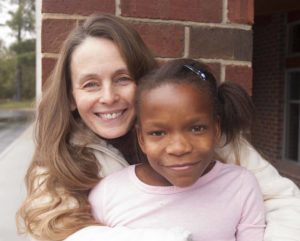
No one from my immediate family showed up when George and I were married. But when Olivia was born, all that changed. George was from Jamaica… a brown man. I was from Maryland; Mom said black Irish. Olivia teaches us about Intersectionality and Bias, twenty years later.

White child calls black man Dad

1016163_656993687661610_189278414_nMorgan
Fort Lauderdale, FL

My now three and a half year old brother named Kendall was born to two crack addicted parents. My grandmother now has full custody of him and is his Mother figure. My grandma goes a few times a week to the Walmart across the street to do her grocery shopping. Benny is a young black man with long dread locks and gold teeth. Works in the produce area and always lends a smile and a good word to everyone he walks by. My grandmother met Benny and could not tell him (or his supervisors) enough how kind he is. Over some time my grandmother and Kendall got to know Benny. She told him about my brothers parents, or the lack there of. Benny told my grandmother that my brother could call him Daddy. Ever since my brother could talk he has still been calling Benny his Daddy, telling him he loves him, bringing him gifts, and even wears a wig (That my grandma made for my brother) to match Bennys dreadlocks. Benny even keeps a picture of Kendall proudly displayed on the mantel in his living room. A difference in skin pigment could never keep this pair a part. 🙂

Enough to make you look pretty

333695_10150352026055540_2251121_oAdrienne Zimiga,
Minneapolis, MN.

I was born and raised on the Pine Ridge reservation my first 12 years. Upon moving from Batesland, SD to Castlewood, SD my caucasian grandmother was concerned that my brothers, sister, and I could face social problems being part Native American (iyeska: mixed blood/race) in an all white community. She told us “Now you don’t have to go around telling everyone here that you’re Indians. Besides your just enough to make you look pretty.” It was a very confusing statement for me as an adolescent. I came from a place where I was very proud to be who I was as a person and now I have my own grandmother telling me it may be best to keep it under wraps that “Indian” part of me. Anyone who knows me knows THAT will never happen. I’m very proud of my ancestry, my culture, my heritage, and my connection to it. It is the driving force that has made me the person I am today.

Who are your ancestors. Be honest.

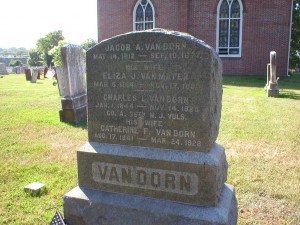
Eliza-Jan-Van-Mater-Van-DornAlison Bailey,
Bloomington, IL.

Yes. I’ve been able to find out who my 3d greatgrandmother is until recently. She was the bastard child of Joseph C. Van Mater, or “Big Joe,” as he was called. The Van Mater family were early settlers in Monmouth County, New Jersey. Big Joe was the largest slave holder north of the Mason Dixon line. He own almost 100 people. His story is mind-boggling, and almost forgotten. I’ve summarized it below.

Eliza Jane Van Mater: Joseph van Mater’s Illegitimate Daughter?
I want to start my story with Eliza Jane because her life, until recently, was a mystery to me. Her grave is marked with an ostentatious headstone, yet the pedigree trail for Louisa’s mother immediately dead ends. Her last name is the only clue to her past. The Van Maters were among the earliest families to settle in Monmouth County, but she does not show up in any of the family trees. We don’t know much about her, but in this case, the backstory is more interesting, and worth telling.

At the age of seven, Joseph Van Mater leaves Eliza Jane the extraordinary sum of $7000 in his will, but the family relationship between the two is not made clear in the will, probated on 20 January, 1821. As one of the most wealthy men in the region, “Big Joe,” as he was called, had an immense amount of property to dispose of upon his death. His first and only wife, Catherine, died 11 months after they were married, and he is reported to be so grief stricken that her never remarried. He gives his land and most of his slaves, furniture and household items and money to immediate family members, and without reference to any family:“To Eliza Jane Van Mater, £1,400.” Eliza is listed in the orphan’s index. The citation reads: “VANMATER; Jan 1833. Eliza Jane VanMater, a minor over 14 yrs, and a legatee of Joseph VanMater, dec’d elected Joseph H. VanMater and Holmes VanMater as her guardians. One charitable reading is that, Eliza was an orphan Van Mater took to kindly, she took his name and at some point elected Joseph H. Van Mater and Holmes Van Mater to be her guardians. However, it was more likely that she was his illegitimate daughter and he saw to it to leave her a large dowry.

Joseph H. and Holmes [I think they were second cousins] were the appointed executors to administer his estate to take care of all of his ‘orphans’, including his “black family, or the black people that have belonged to my family.” George C. Beekman’s book, Early Dutch Settlers of Monmouth County (1919), includes a copy of “Big Joe’s” will, and tells the following story:

A story has been current for some two generations, among the farmers of Holmdel and Atlantic townships, that “Big Joe” VanMater, childless and wife- less, wanted to own an even 100 adult slaves, but although he made many efforts, yet when he reached this number, some accident or fatality would happen, which would cut down his “human chattels” to ninety and nine. As it was, he had more than he knew what to do with. After his death they were all set free, as directed by his will. Many of them by years of dependence for food, clothing and shelter on their easy going, good-natured master, were like children, unable to take care of themselves [sic]. Neither were they content with a new place of abode. They clung to their old home.

It is said that after “Big Joe’s” death the road from what is now the Phalanx to Colts Neck, was black with these newly freed negroes, and they wandered back and forth, perplexed and bewildered with the great change. For it was hard to find another home, where the “black people” would be treated as part of the family, and where there was another man, like lonely, but good-natured and generous-hearted “Big Joe” VanMater.

Many of them sought homes and shelter from Joseph H. and Holmes VanMater, the devisees and legatees of the deceased. For in his will he strictly charges them to take care of the “black people of my family” and “those which had belonged to the family.” This brought upon these two men, all the helpless and indigent ones of this estate, as well as those of their grandfather and father.

There are people….who remember Joseph H. VanMater when he drove over to church at Holmdel on Sundays. Not only his immediate family, but crowded in with the whites, in a big carryall, would be all the colored people who wished to go to church. This burden of the negroes, together with heavy legacies charged in the will of “Big Joe” made a heavy financial load for his devisees to carry. For the land brought in no income except as farmed and the profits were then small.

Caring for so many proved to be costly, and I’m guessing that executors were forced as some point to sell his land. Members of a new utopian community “The North American Phalanx,” the largest and most successful of some 28 communes found in the United States in the 1830s and 1840s purchased VanMater’s estate for their new social experiment. When they moved in they found a number of free Blacks living on the old plantation and simply evicted them.

Sources: Graham Russell Hodges, Slavery and Freedom in the Rural North:African Americans in Monmouth. Oxford, U.K: Madison House (1996); George C. Beekman, Early Dutch Settlers of Monmouth County. Freehold, NJ:Moreau Brothers Publishers, 1919; Judith B. Cronk, Intestates and Orders from The Orphan Court Books of Monmounth County, New Jersey, 1785-1906. Baltimore, MD: Clearfield Company, Inc. (2002).

Wait, why is your grandma Asian?

Ryan Flanagan,
Mountain View, CA

A friend in high school asked me this question after meeting my grandmother, who is Filipino. I grew up eating pancit and lumpia and feel a strong connection to my Filipino heritage, but am often met with eye rolls since my appearance reads as white. I worry that my blue-eyed daughter will be too embarrassed or ashamed to lay claim to this part of her identity.

Family talks, and I get mad

Tasha Thompson,
Coon Rapids, MN.

I’m a 19 year old white female, and my grandma was born in the 40s. She is very old fashioned and when she talks about my mom’s work in a majority black community where the accept EBT, she starts to sneer and act like it’s the worse thing that could happen. It always makes me uncomfortable and I don’t even want to go to holidays anymore because I’m sick of her comments towards black people. It makes me upset that she would even think it is ok to talk like that, but my family just says it’s the way she was raised.

Grandma for grandkids of many colors

Emma Cate,
San Jose, CA

We have four grandsons who are half black, one adopted grandson who is brown, two great-grandkids who are half Chinese. In our extended family, we have people who speak the following languages fluently: German, French, Chinese, Haitian, and Spanish. I think in another generation there will be many families like our family that are very racially diverse and speak multiple languages.

Armenian, Tagalog, Ilocano, no. Wolof, yes.

Dancing-in-Diofior-croppedAnoosh Jorjorian,
Santa Monica, CA.

My paternal grandmother came to the U.S. to escape the Armenian Genocide. My maternal grandfather jumped aboard a U.S. submarine during World War II because the Japanese Army put a price on his head. When they raised my parents, they wanted more than anything for their children to assimilate into America and so did not teach their children their first languages. I grew up a racial mystery, looking neither Armenian nor Filipina, but certainly not “American” either. In 2000, I moved to Senegal in West Africa. Whereas in the U.S. I am a woman of color, in Senegal I became a “white” woman. I understand the complexities and the arbitrary construction of race because I live it in my body every day. I blog more about this as Araña Mama.

I’m white my daughter is black

Jennifer Berkemeier,
Farmington Hills, MI.

I’m a single mom. I adopted my daughter from Haiti in 2012 when she was 4 years old. I’m white, and 15 years older than most of her friends’ moms. We get a lot of stares and unwelcome comments from little kids (“Is she your grandma?” “How come you’re different colors?” “She can’t be your mom…she’s white”). We love each other. We talk about race, her origin, being white and black, and being a non-traditional family. I’m teaching her to embrace it and be proud of it. It’s strange and painful to teach someone about slavery when you’re white and she’s black.

Grandmother ate in kitchen with housekeeper

Alice J Walker
Gay, GA

This concerns a story told to me about my grandmother, who died in 1960 when I was five years old. In the mid-fifties, she lived with my aunt and uncle and their boys in Rome, Georgia. On one rare occasion, she was home alone when Carrie May, the housekeeper came to clean. Grandmother fixed lunch for the both of them; when it was ready, she sat down in the kitchen and Carrie went out on the back porch to eat. It was a cold, rainy day; grandmother said “Carrie, come into the kitchen and eat; you shouldn’t be out there.” Carrie didn’t want to, but grandmother assured her that no one else would know. She came into the kitchen, and the two women ate together.

Grandma said I looked too haole.

Carol Silva
Portland, OR

My step-grandma danced, taught, and had her own hula group who performed during the week on Oahu. Once when she and my grandpa were visiting us on the Mainland, my grandpa suggested that when I got older I could come to Hawaii and dance in the show. This was unlikely to ever happen, but nice of him to say. My step-grandma shook her head and said, “She looks too haole.” Very true, but it hurt to hear her say that I was not welcome. Later on my cousins danced in that group. They were also haps haole, but did not look it. Now when I see photos of me and my cousins I think, “Looks too haole.”

Join the Newsletter

Subscription to our newsletter open soon.

Indulge in timeless elegance with our hand-curated collection of luxury vintage men’s fashion. From classic suits to iconic accessories, our online store offers a premium shopping experience for the modern gentleman who appreciates quality and style. Shop now and elevate your wardrobe with our carefully selected pieces that celebrate the art of craftsmanship and heritage fashion.