X

China, Yellow, hardworking, dream, versatile, active

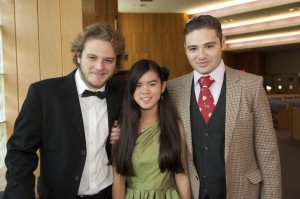
photo (3)Yilan Miao,
Selinsgrove, PA.

Maybe we should improved the inaccurate term “racism” with the much more accurate and potentially productive term “stereotype”. As American people always think, I am really good at math and this is the beginning of the third month for me to study in a small town of America. As you can imagine, the foreigners in the place where I live are really hard to see so it is a normal thing for people to see me surprisingly at the beginning. However, I don’t think that means kind of the racism because people are really nice to me and I have made lots of friends here now. As they start to talk with you the stereotype in their minds begin to break down and they will begin to appreciate your braveness. It is 21st century now, new idea has already had great influence on the racism. I believe as the growth of communications between different race, racism will finally disappear one day.

Yellow: Neither White Nor Black Enough

Photo-64Yuri Yamamoto,
Raleigh, NC.

I am a Japanese immigrant. I sometimes feel lost in this society where race is all about black and white. I often feel that I am neither white nor black enough to contribute significantly to a diversity conversation, most of which seems to be about reconciliation and healing from the slavery. While growing up in Japan, I learned that we were yellow. I don’t understand why there is no yellow mentioned in this country even though there are histories of East Asian immigrants in the U.S. Also, it is frustrating that being an Asian does not seem to count as “minority” when it comes to higher education and jobs even though we are racial minority.
On another topic, while I would like my racial identity to be acknowledged and embraced, I would not like to be boxed into stereotypes. “I’m Japanese and I’m not Japanese”

Privilege cripples; step out, run naked.

viewprofileimageTannya Forcone,
Akron, OH.

My truck isn’t allowed to go faster on the freeway because it’s yellow. Why should my skin color allow me any other benefit? Privilege is embarrassing. Inequality causes our society to stagger in a circle, never moving forward toward justice.

They glare at my bi-racial son.

image5 (3)Linnette Derry,
New York City, NY.

I often think about the inevitable discussion about race that I will have to have with my son one day. That day when he will begin to ask me why people think I’m his nanny/housekeeper instead of his mother; the day when he will ask me why people keep staring at us when daddy is with us; the day when he will ask me what do the words “exotic”, “nappy”, “yellow” and “dark-skinned mean.

But, you don’t look white.

Anonymous,
USA

Growing up I received comments on my olive skin tone. I grew up within a white family and culture. Many curious people often ask where are you from? I reply Florida to only receive “yeah but like where is your family from?” Having previous knowledge and the help of a DNA test I’m 15% Filipino and a bunch of mix-matched DNA my highest percent being 35% Irish. Many don’t believe my Asian Ancestry due to my lack of actually “looking” Asian.
During the Summer I receive more comments as my skin darkens. I have often been mistaken or Spanish or Latina and I have experienced racism from my peers.
I often have trouble with my identity. I don’t “look white enough” but I also don’t “look” Asian.

RESPECT! Skin colour labelling IS offensive

Liam,
United Kingdom

MOVING AWAY FROM THE WHITE SUPREMACIST’S RULEBOOK

Referring to people by skin colour is based on white “supremacy” – which is an ideology that formed over the centuries of enslavement of African people in the Americas.

A skin colour hierarchy was created by white “supremacists” to “justify” the brutalisation and subjugation of enslaved Africans – with “white” at the top, and “black” at the bottom, and several gradations (yellow, red, brown) etc. between the two extremes (master and slave).

Essentially, the less white (or further away from white your skin was), the more akin you were to a slave.

It is time this nefarious colour chart was disbanded, as it is what has led to the modern day problems, of racism and colorism (and even colonial mentality).

These colour labels were not chosen randomly. No one has white skin, and I’m yet to meet anyone who has black skin either – so why were these labels chosen as proxies for human skin colour?

The white “supremacists” knew the power and significance of labels and symbolism.

The colour “white” in many cultures around the world, signifies cleanliness and holiness. (“white lie”, “whitewash” etc.) and they adopted that colour to represent themselves (even though no one has white skin).

The colour black on the other hand signifies the direct opposite – all that is unclean and unholy (“black looks”, black secret”, “blackmail”, “blacklist etc.) and that colour, they assigned to their enslaved Africans.

Calling someone by their skin colour is playing from the playbook/rule book of White supremacy. Out of respect, Chinese people are no longer referred to as “Yellow”, Native people are no longer referred to as “Red” etc. Instead, they are respectively referred to by either the country (or geographic region) that their phenotype seems to visually suggest – NOT BY SKIN colour.

However, the colour “black” which happens to be the lowliest on the white “supremacist’s” nomenclature, is a term that is still widely used – without blinking.

It is worth pointing out however, that as a result of the ranking of the colour “white” in the supremacist’s skin colour “chart”, calling someone “white” does not come with any negative connotation – because of the word’s positive connotations in various cultures. The word “black” however, has many negative connotations in many cultures and in everyday language.

The correct AND respectful way to start referring to fellow humans who are currently labelled “black” is to refer to them as having “African heritage” or “African ancestory”. This will be in keeping with the convention of how other peoples are referred to – which has moved away from skin colour.

So instead of saying “the black guy” say: “he has African ancestory”, or “is of African extraction”. Every single person currently labelled “black” (including Carribeans etc.) can be traced back to Africa (that’s why they look like Africans – DNA doesn’t lie).

The only dark skinned people this rule does not apply to are Australian aborigines, and they are visually different from people currently labelled “black” (look at images of Australian Aborigines on Google if you’re not sure).

For the Australian Aborigines, just call them that (or Indigenous Australians).

That way, we move away from the racist legacy of using a skin colour hierarchical system created by white supremacists to justify their enslavement of tens of millions of Africans over several centuries.

Yellow monkey —model minority. Still oppressed.

Chris C.,
San Francisco, CA.

What is my place and where do I feel comfortable exercising my voice in the race dynamic? Having been raised as a model minority, I wasn’t confronted with race as non-consentually as other races, yet my people continue to be oppressed by the majority along levels of academia, professionally, in media, and more. Where do I plant my foot, and where do I lend my voice? It’s ready to be heard in firm nonviolence.

I don’t see color

Patty Hall,
Alexandria, VA.

I have a precious bi-racial blessing; My Grandson. He doesn’t see color either, but sadly he knows other people do. There’s a song that many of us sang in Church growing up. “Jesus loves the little children, all the children of the world. Red and Yellow, Black and White they are precious in his sight” .

Too yellow or not yellow enough

Jean Tokuda Irwin
Salt Lake City Public Library

“I’m Japanese-American with a Japanese mom and a father who was a GI.”

The Japanese called children like me Konketsuji, or loosely translated, GI bastard child. I was one of the offspring of a a Japanese mother and an American GI during the post-war occupation years, in sort of a modern day Madama Butterfly story. I don’t know if my mother committed seppuko. I was left in a orphanage when I was three or four. Unlike Pinkerton, I don’t know if my father ever returned to Japan.

Join the Newsletter

Subscription to our newsletter open soon.

Indulge in timeless elegance with our hand-curated collection of luxury vintage men’s fashion. From classic suits to iconic accessories, our online store offers a premium shopping experience for the modern gentleman who appreciates quality and style. Shop now and elevate your wardrobe with our carefully selected pieces that celebrate the art of craftsmanship and heritage fashion.