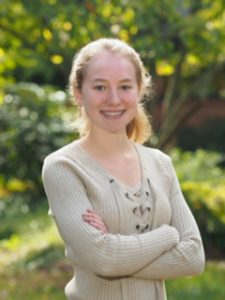
No. I’m not your average face.
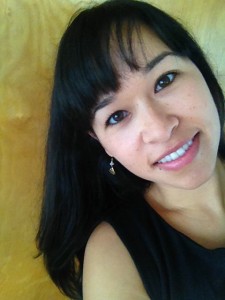
Clara Chun,
Los Angeles, CA.
I’m a Thai-Chinese, Korean, White girl. It’s about as confusing as it sounds, but I refuse to not acknowledge a single part of my identity. Because all of it exists.
The Race Card Project
By Michele Norris

Clara Chun,
Los Angeles, CA.
I’m a Thai-Chinese, Korean, White girl. It’s about as confusing as it sounds, but I refuse to not acknowledge a single part of my identity. Because all of it exists.
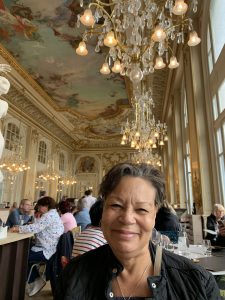
Latoya Baerlocher-Turner,
Newport News, VA.
It’s fun watching people attempt to imagine my face from my name. My first name is notably of African American origin, but my last name tells a different story, so people don’t know what to expect. And it’s always the same vice versa when people who’ve met me, learn my name. I enjoy confusing them. My identity is not merely one portion of me, it is everything that has contributed in total.
Katy Carpenter,
OH.
I recognize that we don’t live in a color blind society, but race is never something I felt was central to my identity, and has no biological base. It never came up until I moved to the Bay Area and people started associating this idea of whiteness as a central component of my identity or what they saw my identity being composed of. After my friends get to know me though, they always come to the same conclusion : “its ok, you don’t act white”, but I sure look it (and I’m left wondering again what these six words mean).
I understand that whiteness has its benefits, and feel guilty that I do not receive the same scrutiny in stores, while driving, or just in my life in general. I think this is an incredibly important conversation to be having, and I will continue to try and understand this conversation on a deeper level. Hopefully some good will come of it-because I am so tired of humans losing their lives.
Janine D Herrera,
Rancho Cucamonga, CA.
When beginning this exercise, I almost regressed back to my old thinking habits. I came up with the six-word phrase, ‘English language no Spanish still Mexican.’ However, I realized I was going back to what I was delivered from. I used to struggle with my identity. I am Mexican America, I speak English and only know very little Spanish. My parents used Spanish to have adult conversations so that my siblings and I wouldn’t know what they were talking about. Therefore, we weren’t taught the language. However, growing up it was a struggle. To my Hispanic Spanish speaking friend’s and Hispanic elders, I ran into, I was teased and viewed as white. When I attempted to speak Spanish, I would be laughed at when I spoke it wrong. I wasn’t Mexican enough for them. However, for the white people I was viewed as Mexican and not white enough for them. Although, I did not identify with white, I struggled with being truly accepted. It wasn’t until I truly committed myself to Christ that I realized my identity was truly found in Him. And it wasn’t until then that I was set free from the boxes society tries to fit or confine me in.
Thanks CBU HIS311
Cesar Ramirez,
Waukee, IA
I feel like I’m navigating my identity. As a Hispanic person born in Iowa to Salvadoran parents, I’ve always felt like I’m stuck between two worlds. My skin is light, so other Latinos often assume I’m not one of them until I speak Spanish. Even then, I’m questioned about how I learned it, as if my heritage needs to be proven. On the other side, non-Hispanics treat me like an outsider, asking stereotypical or offensive questions that reduce my culture to caricatures. These six words capture the feeling of never fully belonging, no matter how much I try to explain or connect.
Liam Sell,
Stone Ridge, NY
p>I am a white male from Stone Ridge NY, I don’t really care who is what race, (I understand that for some people it’s an important part of their identity) I just want to meet a lot of people and share experiences with them.
Aleenah Ansari,
Seattle, WA
I didn’t choose to be queer, but I can choose to live authentically, to stoke conversations about queerness in communities of color, approaching the dialogue with empathy, without judgment, and with respect for people, beliefs and experiences that differ from my own.
I haven’t always known how to talk about my identity, and maybe you don’t know how to have this conversation with folks from the LGBTQ+ community, either. Here’s my ask: Continue to learn and challenge your assumptions. I’ll be doing the same, while proudly celebrating all the different aspects of my identity.
Madison Tounsley,
Pleasant Hill, IA
I am a 19 year old woman who has battled with my ethnicity/race growing up. I am part Asian and part Caucasian I have been discriminated upon for being too tan or not tan enough. It seems I could not fit in or feel understood or seem as either identity.
Amber Nicole Gutierrez,
Hemet, CA.
Everyone grew up with a different life-style, just because I look of Mexican decent does not mean I am the same as every Mexican stereotype. I am an American and have grew up in the middle of both worlds of “American” and “Mexican”. I understand Spanish and speak some. I was not raised in the barrio it does not mean I do not know the culture. I may shout the word Loteria but it does not mean I do not know of the word buenas. I am as American as they come . My father served in military for a 20 years span, my mother was born here as her mom’s mom was. However, I do self-identify as a Chicana. This is due to the wonderful culture of Mexico and the Cesar Chavez Movement for civil rights and belief in higher education. I hope to assist minorities wherever disparities are found.
SHOUT OUT- CBU HIS311
Jake Dinh,
Lake Forest, CA
Being Vietnamese but born in the US created a feeling of disconnection for me neither fully connected to Vietnamese heritage nor entirely embraced by mainstream American culture.This highlights a struggle to find belonging and identity in a space between two worlds. It reflects the complexities in my life of cultural duality and the search for myself in a multicultural society.
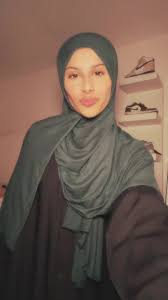
Reem,
Grand Prairie, TX
This six word race-card projects reflects on the common misconception or stereotypes that Arab women who wear the hijab face. Often times people of another race assume Arab women that wear the hijab are oppressed, when in reality it is a choice to follow our faith, identity, and individuality.
Marquez Jones,
Houston, TX
I chose “Black 365 Days of the Year” because in my heart and in the manner that I live my life, I live unapologetically as myself. The identity that I most identify with is my race and although I know that I experience prejudice, racism, and biases, I am proud of my race and my ancestry. I am fully aware that as a black male, it is not statistically expected for me to succeed or even be here in graduate school right now. Therefore, I live my life as a challenge to myself, as a way to prove doubters and statistics wrong, and as a way to show younger individuals who are also black that it is possible to be a successful black male in society. In addition, as I mentioned I am unapologetically black which means that I have no pressure to conform to what others think I should be or to lessen my “blackness” in order to appease others. One example of this is code switching in a professional setting. Therefore, I am proud that I live my life being “black 365 days of the year.”
Janel Ruehl,
Bend, OR
I’m a white American, but that doesn’t mean much to me. It doesn’t feel like a fully fleshed-out identity I can inhabit. “White” doesn’t connect me to any songs, or celebration. It doesn’t taste like any certain food. It doesn’t offer me any tradition for how to come of age, or process sorrow, or understand love. This is my privilege, because being white is the default identity in America, even though it’s no longer the majority. But for me, it is also a loss. Not so long ago, my ancestors were not “white”, they were German, or maybe Viking, or maybe Celt. I don’t know, because all those identities were swallowed up by “white” when they came to America, out of the great fear of being othered for being different- even a little bit. To me, this is the great grief of many people in America: either you hold to a sense of racial identity and are othered, or you give up any sense of identity to become assimilated- a part of the great melting pot that only ever seemed to celebrate bland sameness. I celebrate the ways this may be changing!
Ryann Williams,
Trinity University
In a lot of ways, having two parents of different racial/ethnic backgrounds allows a unique insight into both cultures. It can be extremely enlightening to see how both sides can be so different and yet so similar at the exact same time. However, there is always this feeling as if I am not fully a part of either because of my own interracial identity.
David Pham
Poughkeepsie, NY
When I was young, my mom told me a macabre anecdote about the Vietnam War. She remembered that American soldiers would go through villages in search of Vietcong. As they went through, they would ask villagers in English if they were indeed Vietcong or not. Some villagers, though they did not know English and therefore could not understand, would nod anyway. They were shot on the spot. When my mom told me this story, I refused to believe it. I thought it was obvious that American soldiers would know better than to ask villagers if they were Vietcong because they did not speak English, so it would be pointless. This was never in any of the history textbooks in school, so, of course, I thought back then, the story was obviously not true. Now, after unpacking this memory, I feel ashamed to have questioned my mom’s lived experience and how I internalized so much oppression as a child.
Based on this memory, I define race as the self-constructed, fluid identity that is heavily influenced by outside agents such as people (family, friends, teachers), significant personal events, or the media (in its portrayal, or lack thereof, of racial/cultural images on the television, on the Internet or in textbooks). Race goes far beyond physical appearance. Though race can certainly be ascribed through institutional agents such as the government, race is not fixated but is, instead, robust and moldable in that it is based on self-exploration over time. Only when confronted by oppression does race take on a collective identity (rife with stereotypes), making it seem fixated and ascribed by an oppressive agent when it really is not. Those who are confident in their own racial/cultural/ethnic identity can break free of the oppressor stranglehold and take part in re-humanizing both the oppressor and oppressed. Yet, it takes many years for this to happen after considerable mental and physical toll, reflection and action.
Racism tore me away from my heritage and culture and placed me in this liminal space between my own Vietnamese culture and the American culture I strove for. This was why I questioned my mom’s lived experience. As someone who was striving to be White, I was stunned to hear an account so unflattering of a group in which I wanted membership. Racism, as a tool of oppression, therefore displaces people from their heritage, and from personal experience, and it put me into a cultural/racial/ethnic limbo¬. What is most insidious about racism is that it works in covert ways, and I, for one, was not conscious of my own cultural/racial/ethnic displacement until I entered college. Racism can also devastatingly foster horizontal violence between targeted groups and often times within a racial group to the benefit of the oppressor group. Such was the case when I was forced into my danger zone when I was in a discussion with a fellow AAPI person who said he supported the model minority myth. Racism also drove me to search, depend on, and embrace social capital that would help me succeed in a White-dominated world (such as looking for cheap SAT classes to take). Simultaneously, I devalued my own cultural capital because it did not give me the necessary tools to succeed (choosing to take SAT classes instead of classes which could have developed my Vietnamese writing skills). And so, I clearly remember being jealous of those who had more access to such social capital because it meant they could be more successful than me.
Salem Cardenas,
El Centro, CA
Justina Adarkwah
Christchurch, VA
I’ve always had a problem with identity, but ironically I realized it was me that thought I had a problem, it was society, my community, everyone else who had an opinion about ‘what’ I was and who I should be. I’m not sorry to let everyone one know that its not their decision to make, the colour of my skin has almost nothing to do with who I am, I didn’t ask to be born to my parents, born in my country, speak the way I do, look the way I do so why is it an issue? I can look ‘black’, talk ‘white’, act ‘latino’, study like an ‘asian’. It’s no one’s business but mine. These are all stereotypes and they are named as such for a reason. We are who say we are, I choose to be just human, what about you?
Christina Mayes,
Richmond, CA.
The constant revolving question in my life is, “What are you?” Let’s take care of this question now. My father is Peruvian and my mother is Irish-Italian. My father left when I was three, so for most of my life I felt like he left me with no culture or language. My brown skin did not appear to be a reflection of my mother. As a child I remember questioning her if she truly was my mother. When with her I felt a need to prove I was hers when others looked on. My mother has fair skin and large blue eyes. I envied her characteristics. She tried to assure me that I was beautiful in my own way.
Growing up with the last name “Jimenez” was challenging. Many teachers mispronounced my name and people expected that I spoke Spanish. Whenever I failed to speak Spanish or not meet other expectations such as being Chinese, Japanese, or Filipino because of my small eyes, I always had a sense that people just weren’t really seeing me. I was a constant reflection an reminder of a father who left his child without a clear understanding of what being Peruvian meant.
As it got older I began to appreciate the wonder and thought how amazing that I get to live in a world of blurred lines. My multicultural background is actually a gift. This acceptance of my identity embraced my mothers side of being third generation San Franciscan. Renewing my sense of self in terms of growing up in Berkeley, CA – a true Bay Area native. I felt recharged on life, but also determined to learn more about my fathers side and Peruvian history/culture.
This year my husband and I went on our honeymoon to Peru with my university. On this field biology class trip, I participated as a staff member among the students and faculty. Hidden away was my secret of this being a long overdue heritage trip. My husband held my hand as I cried on the bus through Lima, Peru. I knew that these were the streets that had taken my father two years again in a fatal car accident.
We saw the capital and then traveled the Amazon River. When stopping back in Lima I took a chance and reached out to my younger half brother I had never spoken to or met. You see, my father had a family before me creating a older half sister who is full Peruvian (speaks Spanish, raised in Petaluma, CA) and a younger half brother who is full Peruvian (speaks Spanish, raised in La Molina, Peru). I left a cryptic voice mail in Spanish for my brother who then quickly called me back. His voice was the sound of my father and he spoke excellent English.
We met that day. I had never been so nervous. I didn’t know what to expect and neither did he. When he walked in at. a height of 6’3” – I couldn’t believe it. We hugged, laughed, and cried. I never thought I would meet him in this life. I thought he would be a distant past like my father. I asked if our father was tall and he laughed and said yes. Turns out my 22 year old brother is a college rugby player in his last year of college stud eying international business. As a college advisor for his age group, it seemed oddly kismet as we launched in conversation. I understood exactly where he was in life and he had a greater understanding of where I was.
My brother is older than his years. Our father left him at three as well. We lived parallel lives constantly asking who we were. It’s much more than race.
He share with me that he learned our father was originally from the Amazon. He also shared that he forgave him. I knew as well in my heart that I agreed with this forgiveness and realized it wasn’t the history or culture that I desperately needed, but family. My brothers love is unreal.
All this time I hogue to was in search of myself, but it was actually the connection to another who would fully understand this internal longing of understanding.
As I stood atop Machu Picchu with my husband, I felt so alive and at peace. I thought of my brother and I wished I could be with him. He too is a reflection of our father. I could see clearly the value of what’s so important in life.
My mother has always been my angel in life. I see her as the strongest woman I know. I see her in my face more and more. It’s hard to believe I had once questioned that. Identify and self development can be difficult for those with an unclear family line. When someone asks, “What are you?” I say be bold and true. The conversations that follow are worth the time and educating others.