X

Divide in America demands one listen

When I entered high school, I quickly learned terms like white privilege, white fragility, and microaggressions, which challenged my identity. While I understood I benefited from white privilege, I did not like the label. Still, the racism embedded in our institutions and the frustrated feelings of my friends motivates me to want to be part of the conversation. If I want to be able to meaningfully address the social justice issues in our society, I need to understand race.

What does Puerto Rican look like?

Janet Jimenez
Washington, DC

Puertorriqueño(a) is the “proper” term used to address a native islander from Puerto Rico. Do not confuse with Newyoricans, or anyone else born outside the island to Puertorriqueño parents. A real Puertorriqueño(a) knows the words to “La Borinqueña”, speaks Spanish (FLUENTLY), has lived on the island, and cries to the words of “En Mi Viejo San Juan”. Other terms used to refer to a person from “La Tierra del Encanto” are: Puertorro(a) = a shortened version, Borinqueño(a) = after the island’s Taino name “Borikén”; and Boricua = a variant of the previous. The terms Boricua or Puertorro(a) can sometimes be insulting, particularly to an affluent person. However, average people, especially those from the “caserios”, do not typically mind these terms. I copied this from Urban Dictionary as its the one definition I like the best. People mistake me for Lebanese, or some mixed race Latina. Parents are straight up from PR. Gray eyes on the paternal grandparents side and white skin as well. It’s been an interesting subject to explore. What do you say?

Gay White Autistic Male….Difficult Fit

Joshua K.
NH

Being on the Autism spectrum, I felt that I never fit in with the rest of my classmates because I would always have to have an aide or paraprofessional by my side to help me with subjects that I find difficult. Being white, most people automatically label us as racist because of how society views white people. Also, many Christian people view individuals who are part of the LGBT community as “sinful” and that same-sex marriage goes against God’s vision of marriage between a man and a woman so it’s difficult for me as a gay man to fit in where people don’t accept you as a human being.

I’m sorry I’m staring at you.

Jessica Flake,
Amelia, OH

I work as a demo’s assistant at an international grocery store which will not be named for advertising purposes. Being in Demo’s means I make samples for people to try of various products that we want to sell. I have been called various ‘slurs’ by some people of color in the past (mainly cracker, because I often work in the cheese department) and this has lead to my thinking in overdrive when it comes to race at work. If two people are coming at me and I call to one first instead of the other, have I done that because the first person was closer to me than the second, or because the first person was white and the second was a person of color? This leads to my constant hyper-awareness of the customers that walk past that may be a different race than my own, and I try to call out to them but then how do I know that I’m giving them more attention without meaning to? Thus, my indecisive glances that would easily be perceived as obsessive staring if I didn’t try to occupy myself in other ways.

The fiction of whiteness imperils humanity.

Evan Sorem,
San Diego, CA.

I am a human being. I have lived nearly all my life in California. My ancestors have lived in California, Illinois, Wyoming, Utah, Tennessee, Virginia, Norway, France, Italy, England, the Netherlands and who knows where else. So, people view me as a “white” person.

In my 40’s, I have learned that there is nothing inherent in me to support the notion that I am a “white” person. So, I am now rejecting the label. I am a person. My children are people. My friend, who I heard called a “n*****” by kids driving by in a truck as we walked to his house, is a person too. The humanity of that friend is constantly in danger because of the perception of the kids in that truck that they are white and he is not. But they are not white people. They are people. As is he.

As was Trayvon Martin. As was Michael Brown. As was Eric Garner. As was Tamir Rice. As was Walter Scott…..

If we cannot act to destroy white supremacy. White supremacy will destroy us.

With kids, I’m dad, alone….thug!

Marc A Quarles,
Pacific Grove, CA.

Pacific Grove, I’m African-American my wife is German we have two children a son 15 and a daughter 13. We live in a predominately white affluent area on the Monterey Peninsula in California. Every summer my wife and children go to Germany to visit her parents and other friends and relatives so consequently I spend the summers alone. During the summer when I am alone I’m treated very differently people seem apprehensive to approach me and most of the time I’ve noticed my white counterparts almost avoid me. They seem afraid we’re don’t know what to think of me because I’m in their neighborhood. I often times wonder if they think I’m a thug. The same does not happen when I have the security blanket and shield of my children. When my children are with me I’m just a dad.

NPR continues a series of conversations from The Race Card Project, where thousands of people have submitted their thoughts on race and cultural identity in six words.

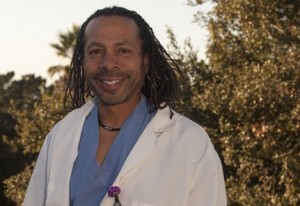
Marc Quarles is African-American, with a German wife and two biracial children — a son, 15, and daughter, 13. The family lives in Pacific Grove, a predominantly white, affluent area on California’s Monterey Peninsula.

november 2014_1960 (1)Every summer, Quarles’ wife and children go to Germany to visit family. Consequently, Quarles spends the summers alone. And without his family around, he says, he’s treated very differently.

Most of the time, “I’ve noticed my white counterparts almost avoid me. They seem afraid,” Quarles tells NPR Special Correspondent Michele Norris. “They don’t know what to think of me because I’m in their neighborhood. I oftentimes wonder if they think I’m a thug.”

“The same does not happen when I have the security blanket and shield of my children,” Quarles says. “When my children are with me, I’m just a dad. I love being a dad.”

Those experiences prompted him to share his six words with The Race Card Project: “With kids, I’m Dad; Alone, thug.”

Many people have written to The Race Card Project about how they feel people perceive them, based on their skin color.
Whites can’t distinguish Harvard from Hoodlum — Alisa Dennis, Los Angeles
Lady, I don’t want your purse — Anthony Freemont
Did you just clutch your purse? — Chima Ordu, Garrison, Md.
I was stinky; I wasn’t afraid — Lynne Shotola, Waukegan, Ill. —
Purses are clutched when I approach — Hiawatha Walker
‘Where Are You From?’

“There aren’t a whole lot of African-American males in Pacific Grove,” Quarles says. “So I think most people do wonder, ‘What is this … black guy up to? … Why is he here, and what is he doing? And why is he in my nice, affluent neighborhood?’ ”

That “stings and bites,” says Quarles, an ultrasound technician. “I have a very decent job. I would take care of most of these people if they came to my hospital. And to assume that I’m anything less than a productive member of the community, that does hurt.”

‘I’m Just A Regular Old Hospital Worker’

Quarles recalls an incident when his family first moved into their second home in Pacific Grove. “We had been in the home for maybe two days,” he says, when the police knocked on the door, looking for a missing purse.

The officer asked Quarles if he had noticed anything suspicious in the neighborhood. “And I said, ‘Like what?’ And he said, ‘Well, the woman across the street is missing her purse.’

“And I looked at him, and I said, ‘So, you can come in and look for it if you’d like. But no, I didn’t take the purse.’ ”

Quarles was surprised when his neighbor approached him a few days later. He walked over to tell Quarles that he was “really sorry about the other day.”

“And I said, ‘What do you mean?’ And he said, ‘Well, the police went over to your house.’ And I’m like, ‘You sent the police to my house?’ ”

The neighbor explained that he did ask the police to check them out, but his family eventually found the missing purse — in their own home. He then went on, Quarles recalls, to ask Quarles where he was from.

“And I said, ‘I’m from here, Pacific Grove.’ And he said, ‘No, really — where did you move from before you moved here to this house?’ ”

When Quarles explained that his family had moved from their first home, nearby, “he looked at me again and he said, ‘You have two houses?’ ” Quarles says the neighbor then looked at him from head to toe and asked, “What do you do?”

“And part of me — sometimes I mess with these people. I’ll tell them, ‘Well, I sell drugs and I’m a pimp. I can get you anything I want.’ … I say it deadpan serious.”

They finally realize he’s joking, Quarles says, when he starts laughing. “And once they see the crazy hours that I work and they see me in my hospital scrubs, then they clearly know I’m not a pimp and a drug dealer,” he says. “I’m just a regular old hospital worker.”

Living With A Double Standard

Quarles’ experiences weigh on his mind when he thinks about his children. His son, Joshua, has brown skin, while he described his daughter, Danielle, as “very, very light. She could almost pass for white.”

Quarles knows the community and the world might treat his kids differently as they grow older, particularly with one child being lighter and the other darker-skinned. “I think the world will have a certain idea of what they are, and what they can become, just by looking at them,” he says.

That difference also comes into play with how his kids see themselves, Quarles says. Several years ago, he says, his daughter’s teacher asked the class to write essays about what the Martin Luther King Jr. holiday meant to them.

In her essay, Quarles’ daughter wrote “that if it were not for Dr. Martin Luther King, she and her brother, Joshua, would have to go to different schools,” Quarles says.

“She meant that she would go to one school, and that her brother, Joshua, because of his browner skin, would have to go to a school other than the school that she attended.”

Quarles and his wife wrestled with if, and how, the family should discuss the issue of skin color together.

In the end, he says, “we decided to … let her grow and potentially approach that conversation a little bit later. Because I think eventually, and unfortunately, someone who’s a little lighter than she is with a little straighter hair, with a little blonder hair, is going to call her out and get her to understand that she does have some brown in her.”

Even so, Quarles says, “I don’t know if my wife and I are doing the right things by not talking about race that much with them.”

But as their children get older, they’re the ones who are bringing it up — like this summer, after a white police officer shot black 18-year-old Michael Brown in Ferguson, Mo.

Quarles says his son “brought it up many times, and continues to bring it up. Because he identifies with being more black than white, although he’s split right down the middle. And things like that do concern him.

“As he’s getting older, he’s getting bigger and stronger and folks are starting to wonder about him,” Quarles adds. “You know, ‘What is he? Why is he here?’ ”

Quarles responds by telling his son “that there are simply things that he cannot do,” he says. “Just because of his appearance and his brown skin, there are things that he can’t do that the other kids can do.”

And if that sounds like a double-standard, Quarles says, that’s because it is. “That’s my answer: ‘It is a double standard, Son. And trust me, one day, you’ll understand.’ ”

Not that Quarles accepts double standards based on skin color. But he’s had to figure out how to rise above them, he says — how to succeed by letting certain slights go. And that’s the path to success for his son, too, he says.

“You can live in this world with that double standard and be successful and have a wonderful life.”

The concept of “race” is racist

Jay D,
USA

Race, amongst other “identity” labels, is a tool used to separate human beings, by pseudo-scientists, politicians, pundits, & marketers. The only way to disrupt the concept, and to emphasize unity through a shared identity, either American or human being. Those who cling to it, will forever be doomed to its tempting embrace. Ignore it, make your own path, and don’t take ‘no’ for an answer. You are more than the labels you’ve been prescribed. Focus on the human element, and you’ll go far.

Define race. Ha I thought so!

Nicole,
Irvine, CA

Who can give a clear definition of race? Does that definition “A race is a grouping of humans based on shared physical or social qualities into categories generally viewed as distinct within a given society” sound familiar?-most of us don’t even know our ancestry until we take DNA tests so can we really label ourselves a certain race?

Whites: reject guilt and self-hatred.

Joseph Miller,
USA

In the Twitter thread that brought me here, NatGeo published two pictures of white people. Both of the six-word captions for these people included the word “ashamed.” All of the non-white people had captions that were variations on victimhood jeremiads. I reject both of these mentalities. The victimhood mentality so enshrined by minorities is shameful. White Europeans were enslaved, conquered, and oppressed at various points in our history, but we don’t whine and cry about it, because that is beneath our dignity. This ubiquitous self-hating masochism we also reject. If you hate being white, I hereby release you from the team. I am a white man. I am proud of the European peoples, whose advances in technology, the arts, literature, politics, and warfare are unrivaled in the history of the world. I am not ashamed of my people’s perceived historical misdeeds: all of human history has consisted of the intertribal struggle for land, power, and resources, and the European peoples dominated this game. This is something we should be proud of, not ashamed of. Guilt, self-hatred, and pathological altruism have been weaponized against white people, who are now well on their way to becoming minorities in their homelands. (Paradoxically, this mathematical fact is both decried as a nefarious conspiracy theory AND openly celebrated as a sign of “progress.” )

At the same time, rhetoric against white people has become increasingly hostile and resentful, even among high-level figures in the government, media, and academia. Certain groups speak of our “privilege” while receiving preferential treatment in employment, public contracts, and university admissions. They speak of our “fragility” while burning and looting cities at any perceived slight to one of their own. They label us “racist” while taking every opportunity to celebrate and advocate for their own races. It has become fashionable to hate white people and to bludgeon them incessantly with centuries-old historical grievances, while simultaneously celebrating and maximizing the contributions of every other racial group. The media especially love to cultivate and celebrate the collective identity of the sacred BIPOC, but is terrified by any sense of collective white identity or shared group interest. In popular discourse, the only time white people are mentioned as a collective is for negative criticism. Why is this? If everyone else can play as a team, why shouldn’t we? Everyone wants to hate on whitey while simultaneously clamoring to get into white countries and enjoy the prosperity and stability we have created. There is one group in particular (I’ll leave it to you to guess which) that loves to criticize white society while ignoring the embarrassing truth that they have never created a functioning society of their own. This is wearing awfully thin with us. You can find parts of this world that are totally free from the terrors of “white supremacy,” but no one is lining up to get into them.

People label me white. Thank goodness.

Jeremiah Friedman,
Durham, NH

As a young man of Polish heritage from both sides of my family, I have many of the physical characteristics that Jews of Eastern Europe share: olive skin, a bumped nose, and curly brown hair. One hundred years ago, my physical characteristics would have placed me in a class of people outside of the “safe zone” that is whiteness in America. I would not have been able to feel such security when I’ve been talking with police officers. I could possibly have been turned away from the university I attend just due to my name. Being labeled as white in America has always left doors open, and never closed them. Being labelled as white gives me freedoms and protections not enjoyed by Americans of different complexions and other racially labeled attributes. Over the past hundred years, American society has chosen to expand the vague term of whiteness to include Jews like myself. Thank goodness.

My Dad’s a cop, Am I Racist?

William McCullough,
Opelika, AL

Especially now in today’s world police get labeled with racists. Why is this? I believe that it’s because of the actions of a few. There are very many racist police in America and they do act upon their so-called beliefs. But because of their actions, all police get labeled as racist. This doesn’t sit right to me. Some people will argue with me on that point but I will argue back. They will say ‘Well the officer who killed George Floyd was white and it was because of his race’. To that, I would say okay and agree with their point. It’s sad this is what makes national news in America. You don’t see the good that has been done or that’s happening every single day. There is definitely oppressing happening among all races but most among the African American community especially in America. It’s still going on today and has as long as anyone can remember. I don’t care what political party your claim or agree with you have to see what’s going on. There is always something to be done whether you are going to stand up and do something about it. It is hard to ignore, especially living in the south. You may not see the harshest parts of racism but there are still small parts in which you see every day. So that brings me back to the point, does that make me racist? I’ll actually make it easier, I’m white am I Racist?

“Racist” label usually means “I disagree.”

Dan Ouellette,
Wayne State

The term “racist” is too often used to express disagreement with someone else. Rather than consider the benign logic behind someone’s viewpoint, it’s just easier to label them a “racist”. It’s the lazy-Susan tool intended to end a discussion, not foster it. There’s a mixed message out there if we’re willing to see it – both racism and critical thinking in America are diminishing, like the sun at dusk.

Join the Newsletter

Subscription to our newsletter open soon.

Indulge in timeless elegance with our hand-curated collection of luxury vintage men’s fashion. From classic suits to iconic accessories, our online store offers a premium shopping experience for the modern gentleman who appreciates quality and style. Shop now and elevate your wardrobe with our carefully selected pieces that celebrate the art of craftsmanship and heritage fashion.